Brad Wardell's Blog


Ooh. 2 page ads

Published on Wednesday, April 5, 2006 By Brad Wardell In GalCiv Journals

We've signed on to do a series of 2 page game magazines in Computer Gaming World and Computer Games Magazine. 

But the question is, do ads drive sales? How many people learn about games from game magazines? It's not an easy question to answer because as active as these forums and such are, they represent only the slightest fraction of the people who play games. 

If I were to take a poll here on where people learned about Galactic Civilizations II, I bet places like Penny-Arcade, Gamespot, Usenet, from a friend (who heard it from some on-line source) would come up.

Which brings us back to game magazine advertising and what affect it has on real world sales.  Two page spread ads in game mags aren't cheap as you can imagine.  But let's say you're convinced that they're potentially worth the cost.

The next question is, what kind of ad should it be?  If you're reading this and have access to a game magazine, go grab it.  I'll wait...

(scratches)

(scratches)

(looks around)

(scratches)

(I could do this for awhile, I'll be right back)

(scratches)

Ah, good. So you found your CGW, CGM, PC Gamer, or other favorite magazine.  Look at the ads. Do they catch your eye? I'm an engineer. I don't care about the beauty of an ad. I only care whether it causes the person to subsequently buy the game.  What ads in the game magazines do you think are effective? Not which ones look neat. Which ones actually might have made you go out and buy the game?

Personally, my eyes are trained to avoid ads. If something looks like an ad, I go right by it.  That means if I see artwork that isn't from a game, or a logo that I know isn't part of editorial, I instantly go by the ad.

The best ad I ever saw was the 2-page ad for Total Annihilation. In the spread it was all in-game action. Like a 2 page mega screenshot of a huge battle with minimal fluff.  The game sold itself and the ad let the game do the selling.

For our 2 page spread of Galactic Civilizations II, we're doing something similar for our first crack at it.  It will, in essence, look a lot like what Galactic Civilizations II does on a wide-screen monitor at super-high resolution. Only the bottom corners will explain the points of the game and where to get it.  We figure, players either want this stuff or they don't.  When it's done, we'll put up a screenshot of the ad.


RightClick 1.2 released

Published on Monday, April 3, 2006 By Brad Wardell In WinCustomize News

Stardock has released RightClick 1.2.  RightClick is a program that enables users to replace the right-click desktop menu in Windows XP.  RightClick menus can have short cuts, data, even widgets embedded into them.

RightClick 1.2 takes all the internal improvements that have been made to ObjectBar and other related technology and integrates them into the program.  It supports embedding of widgets and should resolve the problem in which some users lost their menus during a system crash or other unexpected power loss.

It's available on Object Desktop.

For most entrepreneurs, it's not about the money

Published on Monday, April 3, 2006 By Brad Wardell In Blogging

Since Thanksgiving, I've worked every day, 7 days a week, including Christmas other than last weekend where I took one day off.  Why? 

What drives me isn't money. I'm a computer geek. What money I have I put into computer hardware and other gadgets and most of that is taken care of by the company. I do have a nice car. I drive it the whole 6.2 miles back and forth to the office.  But that's about it.  I don't even have a big screen TV.  My main TV isn't even high-definition. 

And when I have time on the weekend, I enjoy making skins, widgets, and lately computer AI updates to Galactic Civilizations II

That's not to say I don't begrudge the excessive taxation of what I do earn. It really irritates me to be driving on Michigan's ridiculously crappy roads after paying hundreds of thousands in taxes each year.  I guess you'd say I'm tight with money and that's why taxes bug me because the government is so much less careful with it than I am.  Give me a million dollars and I'll try to turn it into some cool new stuff.  Give it to the government and they'll waste it on something stupid in all likelyhood.

When I got to dinners that involve "Entrepreneurs" it's the same story. The money they make is largely a side-effect, a by-product of what they do.  It's not the goal unto itself.  They, we, really enjoy what we do and we happen to be lucky enough that what we do makes money, sometimes a lot of it.

The joke around the house is that I need a hobby. A hobby that doesn't involve what I do for a living. Somehow hobbies end up being part of what we do anyway. JoeUser.com, after all, started out as a hobby and then expanded into what you see now.   I don't like boats or fishing.  So I'll have to find something unusual to have as a hobby one of these days.

But in the meantime, I'll continue to just do what I'm doing, reinvesting what I get back to do more of it and groan about the government confiscating 40+ percent of it right off the bat to squander.

The Galactic Civilizations II Battle Plan

Published on Sunday, April 2, 2006 By Brad Wardell In GalCiv II News

They say that no game can be all things to all people. But that doesn't mean one can't try.  When people see our change logs for the upcoming v1.1 they notice they're huge but what a change log can't tell is the overall goal of a particular version.  Taken on their own, a change log can look arbitrary, even casual in what's being changed. Why are we doing this? Is there a unified vision of what's being changed?

So the first question is, why are we doing these updates?  The answer to that has everything to do with word of mouth. Why is an little indie game like Galactic Civilizations amongst the top selling titles at the major retailers? Surely, it must be the awesome, intimidating Stardock marketing juggernaut. Maybe not. Maybe it has something to do with you -- strategy gamers. Strategy gamers who recommended the game to their friends and coworkers for a variety of reasons.  It's a win-win situation.  We do everything we can to make sure you're satisfied with your purchase and we benefit from good word of mouth because of the free user-input updates.

Typically, a person buys a game, plays it for a month, maybe two, and then it's gone.  If they like the game, they may recommend it to their friends. Our updates are about extending the game's lifespan.  The longer we can keep the game interesting to you, the player, the more value you received from your purchase and the better off we are since it extends the time that you're playing the game.  We also see it as our responsibility. It's a single player game. Therefore, we have a duty to keep enhancing it to make it fresh, this is particularly true of the computer AI.

We've been making Galactic Civilizations in one form or other for 12 years now (the original OS/2 version was released in 1994).  And yet it continues to evolve.  We're happy that the game has gotten such good reviews.  And we're very happy most people seem to like it.  But the favorable reception of the game was important for another reason: Doing updates after release, especially ones that add new features naturally beg the question: Didn't they finish the game?  Had the initial reaction to the game been negative, then that would be a very legitimate question. It's one of the reasons we self-published Galactic Civilizations II. We could wait until we were happy with the game to release it. And that way we could do updates without fear of people saying "Well look at all these updates, it must not have been done".

And that brings us back to v1.1. What are we trying to do with it?  There are 5 main goals for v1.1:

  1. Better Computer Players. Nearly every review has focused on how good the computer AI is. We're very jazzed about that. But like all strategy games, there are a certain % of people who find it too hard and a certain % of people who find it too easy.  The goal of 1.1 is to make the game play easier at lower difficulty levels so that players can be gradually introduced to the game while making the AI much more challenging at higher levels by being smarter, more sophisticated.  For example, a lot of work has been put onto tech trading, handling of transports, ship tactics, planet improvement handling, etc. We read forums, not just here but all over the net. We lurk. We hear what strategies people employ.  If it's an exploit, we plug it. If it's just a really clever strategy, we extend the computer AI to deal with it.  The goal of 1.1 is to have computer AIs that blatantly play smarter.
  2. Cleaner Game Mechanics. The economic system of GalCiv II is essentailly a hold-over from GalCiv I which was a hold over from the OS/2 version.  The goal with 1.1 is to make it clear where the numbers come from, make sure they're intuitive, and make balance tweaks based on player feedback.  We're adding in more tool tips so that players can see where things come from, how they're derived. We're tweaking costs, bonuses, etc.  There is no such thing as a perfect balance.  A good balance to a strategy game is derived by how people play that game. We listen to how people actually play the game and then adjust it based on that.  Nothing particularly dramatic (though social production no longer being wasted is a pretty big change but it's something we've had months to think about), mostly things that just make the game feel...better.
  3. Better User Interface.  When you read how people in the real world are playing your game, it makes sense to try to cater to those playing styles. For example, the ship designer has become incredibly popular. We had no idea it would be such a big deal to design your own ships in a free form way.  So we've put in time to make it better. Other players wanted better ways of managing units, selecting units, keeping track of where units were going, so we have been working on that as well. More hot keys have been added, more buttons added, and so forth.  The overall goal is to improve the game so that you're focusing on having fun (it's a game after all) and the user interface stays out of the way.
  4. Modding.  The long-term viability of many games is modding.  We see it as our job to make sure that modding isn't just something techies can do but rather something anyone can do to the game.  We have some experience in this given that we do run the world's largest Windows modding community. When the modding is done, players will be able to download a mod and then from the game point to that mod and make use of all its changes without having to mess around with editors and images.  To help in mod creation, 1.1 will include a pretty significant set of mods in itself to use as examples.
  5. More Gameplay options. This is something that will be an on-going thing.  We don't want to have a crazy # of options, but we do want people to be able to have the game play the way they want. For instance, some people don't like tech trading. So we put in an option to eliminate it.  Other people didn't like that you could see where the other empires were from the first turn, so we put an option to not be able to see controlled territories until those areas were explored. Some people don't like minor races, so we put an option to not have them.

Our schedule right now is to have another beta this week which should introduce the modding.  We will continue to iron out bugs in the beta, tweak balance, and then after that we'll release it as a non-beta. Originally we wanted to get 1.1 "done" by the end of March. But we wanted to have some extra time to tweak and balance things, which in turn add bugs, which in turn have to be fixed.  But we're getting pretty close now. Hopefully users of v1.1 beta 2 like what they see. And soon it'll be done.

And then what? Then we'll start in v1.2 with features we haven't even thought of yet.

Update: The Modding UI may got into 1.2. Mod docs will go out with 1.1.

Galactic Civilizations II: Free gadgets!

Published on Saturday, April 1, 2006 By Brad Wardell In GalCiv II News

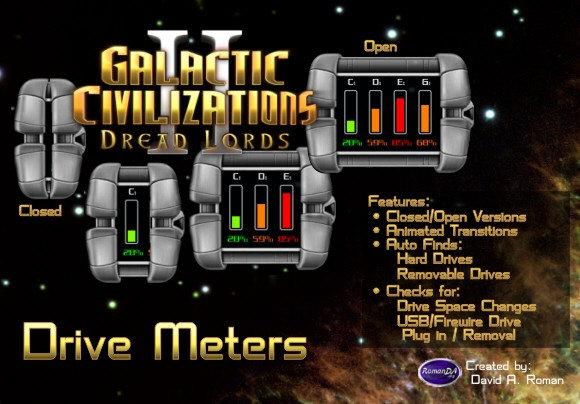
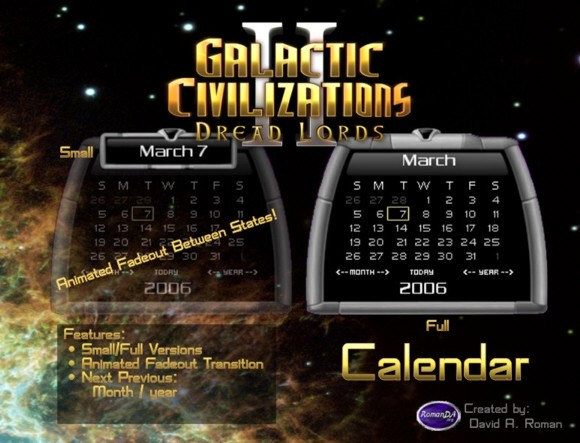
Expert skinner, RomanDA has used DesktopX Pro to create 3 Galactic Civilizations II gadgets.  DesktopX Pro is what was used to create the user interface in Galactic Civilizations II. All the screens are in .DXPack format in your \screens directory.  But DesktopX Pro can also export your creations as actual stand-alone programs.

Below is the first set of Galactic Civilizations II gadgets. They're free!  More to come! Have fun!

Drive Meters

Calendar

Weather

[Download]

[Download]

[Download]

WindowBlinds acquired by Yahoo

Published on Saturday, April 1, 2006 By Brad Wardell In WinCustomize News

April 1st -- 2006.  Stardock is pleased to announce the acquisition of its popular desktop customization program, WindowBlinds by Yahoo.  Yahoo, which recently bought Konfabulator, a popular widget engine, said that adding WindowBlinds to the mix was a natural next step:

"Our goal with Konfabulator, now Yahoo Widgets, was to enable the community to make use of our rich API set in a practical matter.  With Yahoo widgets, users can create mini-applciations that rest on their desktop," said Tony Stein, Vice President of the Yahoo! Developer Network.  "With Yahoo Skins, those same APIs can be integrated into the Windows GUI itself."

WindowBlinds 5.1, originally expected to be released late summer 2006, will be rebranded as Yahoo Skins. It will include a simple SDK in which skinners can incorporate "widget-like" content into title bars, borders, the Start Bar or anywhere else the skinner can imagine.

"We're very excited about this.  Before, users would have to hit a series of hot keys or move their windows, or turn their head to see a picture of their dog or know the latest weather conditions," said Brad Wardell, President of Stardock Corp.  "With Yahoo Skins, your local weather conditions will be part of the title bar itself. Your day planner part of every border. Even the Start menu and Start bar can include a picture of your dog or stocks prices."

For new users, the best news will be that Yahoo Skins will be free.  Existing customers of WindowBlinds, who paid $19.95 won't be receiving their money back. Explained Wardell: "I am really hoping to buy a boat one of these days. I'm actually afraid of water and won't go in it, but I just like the idea of having a boat.  Obviously, that boat won't come cheap so we can't refund people's money.  But I think our customers will be satisfied with Yahoo Skins and that most of them would want me to have a boat."

Yahoo Skins should be available for download by early Summer.

(april fools)

WinCustomize Turns 5

Published on Saturday, April 1, 2006 By Brad Wardell In WinCustomize News

They say that if you get old enough, you forget your own birthday.

WinCustomize has officially gotten old enough to forget its own 5th birthday! LOL.

On March 13, 2001, WinCustomize was put up.  The first news item read:

We're up a lot earlier than we had planned on. With Skinz.org seeming to be gone, we wanted to get something up that users can count on.  We are going to try to make WinCustomize.com into a skinning protal that helps users find the other cool skinning websites like DeskMod and Deviant Art and such. But at the same time, we want a website that users can truly count on.

It's truly astounding how much has changed.  Originally, the site was going to be a portal to other sites.  Stardock didn't want to get into (or pay for) a full-blown skinning site.  So the site was given two missions:

#1 To be a site skinners could count on to be up for the long haul.    And #2 To support a community of skin sites to help get them going.

As time has shown, these are somewhat conflicting goals.  Nowadays, because the community has become so stable, it's hard to remember a time when skin sites would go up and down. A skinner would upload their work to a given site, thinking it would be safe, only to lose it all when it went down or because it had a hard drive crash or whatever.  Many truly great skins from the dawn of the skinning "age" were lost as a result.  So this site was created so that people would have a place they could rely on. And here we are, 5 years later where none of us, including myself, even remembered that March 13th was a historical birthday for the website. 

Over the years there's been a consolidation on the # of active skin sites but also a consistency as well.  While not as many new sites have been created in the past year or two, there haven't been too many closings either.

This year we have a lot of things planned for the site.  Thanks to the success of Galactic Civilizations II Stardock now has a budget to upgrade its overall network infrastructure which will pay real dividends for WinCustomize.com.  New features, more servers, more developers.  Subscribers will continue to see their perks increased over time as we'll be able to have more dedicated "stuff" for them both in terms of servers and content. 

We're also looking to bring someone on whose job will be to oversee WinCustomize.com and Stardock's other websites.  Sometimes things here may seem inconsistent in the amount of front page attention WinCustomize gets because well, as much as I love all you guys, WinCustomize is only part of what I do.  So when things get busy, I end up not doing things like...well updating the poll or putting new news items up and that kind of thing (and other people for some reason don't submit news items often).  So we'll be bringing someone on there.  We also hope to finally be able to bring Jafo on full time.  Consider this, Jafo, who many of you know, is a volunteer. He volunteers his time and energy freely to the community.  He gets nothing in return on than the gratitude and appreciation of us and the community.

Year 5 is looking pretty exciting.  Think about this -- by the time WinCustomize hits its 6th birthday, next March, Windows Vista will be out.  And like an iceberg, you only see what's on the surface right now.  A significant portion (probaby about half) of Stardock's development focus is currently working on stuff for Windows Vista.  Some things subtle. Some things won't be out right away. But great things are afoot.  The skinning age will dramatically change because the desktop will be a 3D surface (it's still 2D as a UI of course) with all the possibilities that implies. It will open the door to more types of skinning than ever before.

So hold on to your hats, because you ain't seen nothin' yet!

Fairness in computer AI

Published on Friday, March 31, 2006 By Brad Wardell In GalCiv Journals

Every so often someone, usually someone who just got beaten, will start screaming that the game "cheated!".  It's a lot like the neighbor kid who screams "cheater" every time he loses at a game.

One of the reasons people like Galactic Civilizations II's AI is because it doesn't cheat.  But that generalization is only true to a point -- it doesn't cheat until AFTER "intelligent" (aka "Tough" in the overall difficulty slider).  Few players can beat it at that difficulty level and that's where meticulous care was put in to make sure that it's playing exactly the same game as the player.  Beyond tough, all bets are off.  At that point, we're talking about players who have either found an exploit or are simply incredibly good at strategy games and our goal then is to make sure they have a challenge. 

At Intelligent, it's playing its best game, same rules, same money.  At genius, it gets a 125% modifier to its bonuses (economically mainly and ability bonuses).  In practice, it just makes them a little bit spunkier as no AI can be as efficient as a human in a crunch so this is the level I recommend for people who are really good at the game who can beat intelligent.  And the last one is called "Incredible" where we're doing everything we can to beat the player.  200% modifier to bonuses, the intuition algorithms are set to be very lucky, etc. Basically, the player's a god at this point and we're doing all we can do beat the player, no holds barred.

The difficulty levels (from the manual) are:

  1. Fool.
  2. Beginner
  3. Sub-Normal
  4. Normal
  5. Bright
  6. Intelligent (this is where the AI is playing the same game you are with no bonuses or penalties with its best algorithms)
  7. Genius
  8. Incredible

In most games, the AI begins cheating right away or at such a low level that even casual strategy gamers have to raise the level well beyond anything that is remotely "fair" in order to be challenged.  In Galactic Civilizations II, it's not until near the end that the game is tilted against the player.  Again, this is in the user manual so this isn't some state secret. 

In the development journals, we talked about the goal of having the "intelligent" AI being able to beat 95% of players.  I think we succeeded.  In v1.1, our goal is to maintain that 95% (as people get better at the game some will eventually be able to beat the "intelligent" AI so we have to evolve with them).

So where do people scream foul and why?

  1. Claim: "The AI knows where the good planets are".  This is largely a carry over from Galactic Civilizations 1 where they did know where the good planets are. As any experienced GalCiv 1 player can tell you, that advantage was really pretty minor in the bigger scheme of things.  A good player can colonize as fast as the AI in GalCiv 1.  In GalCiv II, it's even easier because if you have Stellar Cartography you can see the planets on the mini-map. 

    However, we knew that many people used the GalCiv 1 AI advantage to say "the AI isn't totally uncheating" so a lot of work was put into having the AI design, build, and scout out planets. And I mean a lot of work.  To a user, scouting is easy, they "look" at the mini map. But having the AI do it intelligently took some work.  Even things like how many scouts to build, when should it build them, where should it send them, involved a lot of work to do it well because every move at the start of the game is crucial.

    In 1.0X of the game, we even put in additional checks to make sure that this was the case since there were cases where the bIsKnown flag could be uninitialized and have some junk in it (and as any C/C++ coder can tell you, if you're doing a if(bIsKnown) and there's garbage in there it'll return true.

    But this scenario has been played out over and over again, tested, verified by us, other players, etc.  Anyone with the demo can test it for themselves too. It's very easy to verify that the AI does not know where the good planets are.  Now, at "Incredible", it's hard to say.  The ability bonuses and some of the simulated intuition stuff gets murky when you're multiplying everything by 200.  But that's not material to our discussion since the AI at Genius and Incredible is getting advantages over the player and has always been stated as such.

    For instance, at 200 bonus, the sensors are probably so powerful that they have no real fog of war. 
     
  2. Claim: "The AI builds too fast."  This part almost always rises out of, sorry, "newbie" players who don't realize you can quick buy things. Decent human players do this, and you can bet the AI does this when it can.  The more money it has, the more often it can quick buy things.  On the planet screen, that's what the "Buy" button means.  A player starts out with 5,000bc.  You can literally build something every turn for dozens of turns without any special advantage.  At the highest levels, where the AI gets money, it can go even longer. 

    This particular claim I find especially annoying because it sounds a lot like the neighbor kid screaming "cheater" because they don't know how to play the game effectively yet.  It would be much better for the person to simply ask on a forum and then someone could tell them how it's being done (or read the manual).
     
  3. Claim: "The AI trades with each other too much."  This is another one of those "I'm losing so the game must be cheating" type things.  In 1.0 to 1.0X the AI literally does a ulPlayerIDToTradeWith = rand()%(ulNumberOfActivePlayers);.  IF it's the human player, it pops up a dialog and offers to trade X for Y. ELSE it just simulates the same thing with the other player deciding whether they want to make the trade or not.  In 1.1, it still does much the same thing but I made it a lot less likely for the military techs to get traded if they're expensive since it was very annoying having each player having the same military techs. 

    The point being, the AI isn't making a distinction between the human player and another computer player.

Now this isn't to say there isn't some bug or something.  But I haven't seen it and I haven't seen one other than the bIsKnown initialization issue and even that would likely only show up on a saved game and was fixed weeks ago in 1.0X (and I was never able to reproduce it, I just saw that it wasn't being properly initialized and that the variable wasn't being loaded correctly from saved games).  So it's possible that there is some bug. 

For example, I haven't looked into this because I didn't write the code but the AI may know where galactic resources are.  I say that because during the beta, galactic resources showed up on the mini-map.  IF that's the case, we'll likely have galactic resources show up on the mini-map again (assuming they don't already) because there really shouldn't be a "Race" for them, they should just be known IMO.  But as a practical advantage, it's pretty minor. By the time you've found your planets, you've probably also found the galactic resources.

Consider some of the things the AI has to do, in order to play by the rules and still be effective:

  • It has to design its own ships. You think you have trouble deciding whether to put an extra sensor or life support unit or weapon on a ship? Try being a computer player trying to fit every last thing on the ship without cheating. Think of all the possible combinations of fitting stuff onto a ship to use up every last bit of space.  Think about what weapons you would put on and what defenses you would put on.
  • Similar to the first point, having to figure out which weapons and defenses to focus on. Not only does it have to focus on them and research them but it has to figure out when to research them and do so without being scripted.  It has to know how much offense and defense to put on.
  • It has to know whether it should be focusing on range or speed based on different galaxy sizes, different numbers of players, etc.
  • It has to know what to build on a planet and when.  Should it use that special food tile for a farm or put a factory on it anyway because it needs the production more than it needs the money?
  • It has to know when to know when it should be building colony ships as opposed to freighters as opposed to constructors.  In Civilization IV, my favorite TBS, the player might build a dozen or so "workers" throughout the game. Workers don't get consumed when they're used, they stick around the whole game.  But in GalCiv, you have constructors which are consumed and you have freighters, which are consumed, and you have transports, which are consumed which means a LOT more decisions have to be made on what to build on a planet.  And some of these units are expensive.
  • It has to do a lot of work on the diplomacy, there's a lot of factors to take into consideration.  Because the game has no political borders which in other games prevent players from doing a sneak attack, GalCiv's AI has to be on the look out for all kinds of threat patterns and do so intelligently.  Plus, you don't want players going to war with you one turn and then asking for peace the next. There has to be a good, logical, intuitive reason why it goes to war.
  • The game has fleets AND those fleets are bound by logistics. In other games you either have armies/fleets or you don't.  If you have them, there's no practical limit to how much stuff you can cram in them so they can just go around wreaking havoc.  In the games that don't there's no effort in having to put together such an army.  But in GalCiv II, the AI has to decide how big of a fleet to make, when it should be used, what ships to put in it.  Plus it has to research techs to increase those logistics abilities. When should it research them? Why?
  • The tactical battle AI could take pages to explain.  In most space games, they don't have an open surface so there's plenty of choke points and a very limited # of places a fleet can go.  In most land based games, you have mountains and oceans which create choke points as well.  But in GalCiv II, it's open space which means that it's very very easy for a human player to outflank or use mobility to win the day.  The AI has to deal with that kind of thing. It has to know when to flee or avoid a target, to circumvent an opponent to go to a more valued asset.
  • The AI has to contend with special invasion ships. In other games, any unit can invade. In other games, one can build a transport and send it over and not worry about having to escort it.  In GalCiv, the AI has to decide when and how to escort a ship.  Escort too much and you lose the initiative. Escort too little and you lose billions of troops in space.

And it goes on and on and on.  So when you look at the claims people have made above, they're such small potatoes compared to what is involved in writing a computer AI that is playing by the same rules. 

If I were going to have the AI cheat, I'd do things like give it more space on its ships. That would be a wonderful advantage.  Or I would teleport ships outside the fog of war so that it would be easier to coordinate attacks.  Or I'd bump up its logistics ability so it could fit just a bit more in the fleet.  Or maybe I'd sprinkle its worlds with just a few more special tiles.  But I don't.  Because the AI doesn't cheat.  But it would be so much easier if it did.  And so you can probably see why I get so annoyed when some new user or hack reviewer tries to build their own credentials by making cheating allegations.  Because I could have saved a ton of work if I had had the AI cheat.

And claims like "The AI colony ships knows where good planets are" are so annoying because first, it's not true and secondly, even if it was true, it's such a trivial advantage compared to the real tough stuff that players take for granted.  As most veteran GalCiv II players can tell you, they typically out-colonize the computer AI because human intuition is better than simulated intuition anyway and that would still be true even if it knew where the best worlds were.

But let's say that the game cheats. Let's say it cheats like crazy.  That would put it on par with pretty much every other strategy game out there.  Hearts of Iron 2 is a really good strategy game isn't it? Very popular in Germany?  Yet its AI isn't even remotely playing the same game as the human player. Does that make it a bad game? No. 

The reason Galactic Civilizations II's AI doesn't cheat isn't because it makes it more fun or it's a good marketing tool, it doesn't cheat because for me, as a developer, the whole point of the exercise of writing a strategy game is to write the AI.  That's why our graphics usually suck in our games because I tend to only care about the computer AI.  

The point being that there's no real business justification for me to be coding on the game other than I love coding computer AI.  It's what I love to do.  I love hearing about other people's strategies. I love making tweaks and enhancements to the AI.  I love adding in new features.  But I also get very annoyed when some user or "reviewer" makes "it cheats" claims without even talking to us.  Odds are, they either misunderstood something.  But let's say they found a bug (which isn't likely but for the sake of argument) unlike the AI, we're only human. Who knows, I could make a mistake.  The AI doesn't escort its ships as well as I try to code it, it's possible that I missed something.