Published on Wednesday, March 17, 2010 By Brad Wardell In Business Experiences
The problem with being success is that it tends to make whatever you do bigger. I never intended Stardock to get as large as it is today. I remember years ago saying that I would put a hard limit on Stardock’s growth at 50 people. That seems quaint now.
For those of you reading this who worry the American dream is going away, fear not. I started the company with nothing. No venture capital. I was in a dorm room and working multiple jobs to pay for school. You can still succeed with hard work and good judgment.
That said, I’m having a hard time knowing now where (or if) to stop further growth. The only reason we’re not bigger is that we’re so busy that we don’t have time to interview often (and I apologize for those of you who send us your resumes, we’re trying). Bigger teams help get more sophisticated products (software and games) to market. Impulse is growing at a far faster rate than we had projected. There’s even talk of building a second building just for Impulse in the next year.
It’s amazing how easy it is for these things to just start growing beyond what you had ever planned.
Published on Wednesday, March 17, 2010 By Brad Wardell In PC Gaming
After Elemental gets released I’m going to kind of take a sabbatical from Stardock and become a modder. I’ll focus mostly on modding Elemental and when Civ V ships, I’ll mod that as well. I really would like to see modding of PC games to become more mainstream as they are one of the big advantages they have over consoles.
Published on Wednesday, March 17, 2010 By Brad Wardell In Elemental Dev Journals
I’m back from the Game Developer’s Conference. Lots of fun. I did a lot of demoing of Impulse::Reactor but also showed a few journalists what we were doing in Elemental.
The most common question I got is how is Elemental different from other turn-based strategy games (ala Civilization or Galactic Civilizations).
The answer: Elemental is a much more personal experience. In Civilization or GalCiv, the player exists outside the game. It is about (as their names imply) their civilization.
Putting you in the game
In Elemental, the player starts out in the game, by themselves. They literally must build their kingdom (or empire) from the ground up with nothing. When starting up in the sandbox mode, the player is asked who they are and can design (both in terms of traits as well as visuals) what they are like.
The connection between your army and your people
Similarly, when you build armies, the number of people in your “units” matters because each one comes from your town. Early on, an outpost or village may only have a couple dozen people. Thus, each person you draft from your village is one less person there to grow food, build houses, research technology, etc.
Our goal is to avoid abstracting your armies. If you zoom in, you will be able to see that every person in your army is different (even if it’s just cosmetic) to help send home the point that these virtual people are part of your cause.
Your dynasty
Similarly, because we’re a fantasy title and not historical, we can put the player as the head of a multi-generational dynasty. Thus, your sovereign’s virtual off-spring can be sent off to battle and be put in danger.
The Reaction
The reaction we got from this was very positive. Over the coming months, we’ll be fine tuning this experience with the beta testers. And since we’re our own publisher, we’ll take as long as we need to get it right.
Published on Monday, March 15, 2010 By Brad Wardell In Elemental Dev Journals
At GDC 2009, Stardock released GOO (Game Object Obfuscation) for developers to begin providing some intellectual property protection for their games that did so without annoying legitimate customers. The idea behind GOO was to put together a system that followed the Gamers Bill of Rights but still was acceptable to publishers looking to keep their games from being casually pirated. Since then, it has been adopted by several developers and publishers including Paradox and THQ.
At GDC 2010, Stardock debuted the full Impulse::Reactor. At the risk of hyperbole, Impulse::Reactor is revolutionary.
I realize it’ll be compared to other development tools released previously but the technology of Impulse::Reactor is something quite new. Let me show you why with these 5 reasons:
#1 Setup is automated
Again, if you’re not a game developer, you may not see the significance. But now, publishers and developers can set up their Impulse::Reactor accounts through an automated process. This includes defining achievements, using GOO, generating code, etc.
Sins of a Solar Empire: Trinity will soon be updated to support achievements.
Adding achievements to your game is a matter of visiting the website and defining them. Then click on the “Generate Impulse Reactor code” and it will actually generate source code.
#2 Implementation is incredibly easy
I want to emphasize that this next screenshot indicates all the lines of code necessary to get basically set up. This is what makes Impulse::Reactor revolutionary.
The developer simply includes 2 files: ImpulseReactor.dll and ImpulseReactorOverlay.dll into their game along with a subdirectory which contains the skins.
The Overlay is the key because rather than developers having to call dozens of APIs to build their own UI, they simply call the proper Impulse::Reactor screen and then get the callback information as plain XML.
Because Impulse::Reactor does NOT require the user to bundle a third-party client, the screens are included as part of the overlay into the game itself. This is important because it makes it easy for developers to skin the overlay screens to match their game experience.
This screen capture includes all the setup code AND the code to add achievements. It gets generated from the website.
#3 It’s Vendor neutral
As game developers, we pour our hearts and souls and money into making games. We don’t want some third party to come in and take over that experience or take all our customers.
Impulse::Reactor doesn’t rely on an external client and is skinnable. In addition, users can logon with their Facebook, Twitter, and soon Windows LiveID, OpenID and other means if they want.
This way, users don’t have to keep track of yet another username and password if they don’t want to. The data is anonymzed. This way, their game should cause no issues to be released on all digital distributors and retailers.
Developers can skin the logon and let users logon with their Facebook or Twitter account
#4 Seamless integration into the game
Stardock’s “non game” business has included products like DirectSkin, DesktopX, WindowBlinds, ObjectDock, DeskScapes and countless other products and technologies. When Microsoft, Dell, HP, AMD, nVidia and so forth need technology to brand their programs, Stardock is the go-to company for this. That cool custom UI on GE’s medical equipment? That’s our tech. That app with the custom skin? Probably our tech behind the covers.
What makes this possible is that over the years, we’ve perfected the ability to integrate our code into the user’s process. This is important because the alter native way to do in-game “overlays” is for an external program to run and then for it to “blit” the screen into the game. The problem with that is that it is very obviously not part of the game and requires the game to distribute the external client.
Developers can choose to have screens come up as part of the game or if they don’t want to implement that, they can define a hot key to pop up the Impulse::Reactor control panel.
The advantage of Impulse::Reactor is that developers can customize their screen by changing the .PNG files and XML in the ImpulseReactor sub-directory to make these screens fit the game itself.
From a feature point of view, Impulse::Reactor provides features like GOO, friends lists, posting to Twitter/Facebook (if the gamer opts in), in-game DLC, achievements, chat, multiplayer matchmaking, rankings and ladders, server lists, virtual drives, and more.
#5 It’s FREE
The only string attached is that the game has to be available non-exclusively on Impulse at the same time as it is available elsewhere. The BETA for Impulse::Reactor began today with key internal partners with its general availability this Summer.
Published on Saturday, March 13, 2010 By Brad Wardell In Demigod Journals
I’m on the plane on my way back from GDC and was thinking I hadn’t made a Demigod journal in awhile.
For those of you who don’t know me, I’m Brad Wardell, President & CEO of Stardock and the publisher of Gas Powered Games’ Demigod.
One of the big questions I get from Demigod players is – what’s next?
Right now, there is no definitive answer to this. But what I can tell you is what we hope to do on Stardock’s side of things to help Demigod in the future.
So what I am putting forth here is a vision of what we would like to see happen with Demigod.
Let me break this down into 2 parts:
1. Improving the game itself
2. Improving the Multiplayer experience
Improving the game itself
As modders are aware, Demigod can be heavily modded using LUA. I have talked about the idea of letting the community have more input into Demigod’s “unofficial” evolution in the future with Chris Taylor (CEO of GPG) at various times and he has been enthusiastic to the idea.
It is our intention to work with the modding community to incorporate many of the community improvements into the game.
I would like to see it where a future demo of Demigod allows people to play with users who have the full version (demo players would have fewer Demigods and fewer maps) so that the MP community could be greatly expanded. However, to make that worthwhile IMO item #2 needs to be addressed.
Improving the multiplayer experience
It is no secret that I’ve been somewhat of a critic of Demigod’s online experience. The sausage factory of game development sometimes results with non-ideal solutions.
However, in my opinion, Demigod represents a fundamental opportunity to demonstrate the upcoming Impulse::Reactor features that are making their showing in Elemental.
In Demigod, Impulse::Reactor is only used to display available games and accepts XML data uploaded from Demigod. The actual connectivity (getting players connected in the lobby) is a custom solution we developed AFTER Demigod shipped to replace the licensed system that originally came with the game. The lobby itself and such is provided via LUA scripts.
By contrast, Impulse::Reactor’s upcoming MP solution is designed to provide a lot more MP functionality for developers. For instance, tournaments, match making, ladders, scoring, etc. are all handled by Impulse::Reactor itself instead of being implemented by the developer (the developer simply includes the DLL.
Now, Impulse::Reactor can’t magically address everything. It still requires the developer to submit the stats to the server (an ongoing issue for hard core Demigod players) but what it can do is greatly ease the implementation of a given game by eliminating the current lobby and allowing for a lot more MP options that are currently in the game.
When would all this happen? Honestly, not for awhile because right now, everyone is just tapped. GPG is working on Kings and Castles and Stardock is working on Elemental. But there’s a lot of things that can be done between now and this time with the first item.
Impulse::Reactor is designed to allow developers to implement advanced multiplayer features into their games with minimal effort.
Published on Saturday, March 6, 2010 By Brad Wardell In Elemental Dev Journals
Greetings! It’s that time again where I try to answer some of your questions regarding Elemental, the beta and more.
Q: When is BETA 2 scheduled to start?
A: Beta 2 is the Multiplayer beta of Elemental. We still have quite a bit of work to do in order to have it in a state where it can be provided to the external beta players.
It was originally scheduled for March 18th but has been pushed back to a new tentative date of April 1st.
Q: What sort of multiplayer will BETA 2 have?
A: The initial beta will be very focused on just 1 on 1 MP matches in order to test out the matchmaking. There won’t be custom games in the initial BETA 2. Instead, a player will logon to the Metaverse, press “find game” and be matched with another player. The objective will be to see how well the system works as well as kill off any connectivity issues early.
Q: Will BETA 2 be fun?
A: Actually, it should be reasonably fun by that point. It will be the first update that actually attempts to have some basic balancing in it and enough gameplay elements enabled that the game should start to come together.
Q: What changes from the current public beta do you see (in terms of game play) in Beta 2?
A: We are working to implement the feedback being posted by the beta group. A LOT of that feedback comes in the following areas:
Cleaned up economics. We want to eliminate the “black box” effect that users have discussed at length. Hence, cities will no longer provide any innate money, research, or spell points. That will come from what you build.
A lot more city improvements. Right now, early in the game, there isn’t enough to do. There will be a lot more choices on what to build in order to give players more strategic directions to go into.
The Dynasty system will be updated such that players can negotiate whose family off-spring goes into rather than females going to the other family and males staying in your family.
The game mechanics will be a lot clearer in game. By BETA 2, a player shouldn’t feel lost on what they’re doing. Thus a lot of UI changes are being worked on.
Q: Elemental’s economic system seems to change a lot. Why is that?
A: The biggest reason is to test modability. We expect Elemental to allow players to construct their own economic system in mods. The only way to make sure we’re not hard-coding things into the source is to try out different systems. To put it in RTS terms, modders should be able to make mods that change the economic engine to be like Total Annihilation/Supreme Commander or like Warcraft/Starcraft.
The other reason is that as we play the game and listen to players, we get ideas on how the game should be played or what is more fun.
Q: What about stability, crashes, memory?
A: This is another requirement prior to beta 2. For Beta 2, basic memory usage and stability have to be taken care of.
Q: Are there any other blockers?
A: Yes. Beta 2 won’t go out until we feel it is not just technically solid but as a game it is starting to feel like a game and not a tech demo. The beta 1 series is more like an “alpha”. That is, very very early in the game’s development. The objective has been to talk to players about game mechanics ideas with players having a point of reference. And from that, we’ve been able to (as beta testers have undoubtedly noticed) make pretty dramatic changes based on that feedback.
Q: Will there be any other beta releases BEFORE Beta 2?
A: Maybe. We are considering having a build that implements more of the game mechanics and such and then have beta testers vote on whether they believe the game is ready for Beta 2.
We’re not kidding about the “Limited” aspect of this. We’re currently only planning to authorize the production of 10,000 of these. But for those of you who, like me, miss the “old days” of Ultima IV and such when games came with big maps, cloth maps and other goodies, here you go.
Published on Wednesday, March 3, 2010 By Brad Wardell In PC Gaming
Originally developed by Cavedog back in 1997, the rights eventually came into the hands of Atari who has given us permission to re-release it.
Stardock is handling the support for Total Annihilation directly and includes a new launcher that helps automatically configure the game for modern systems, streamlines getting multiplayer games going and includes easy access to tips and tricks for getting the most out of it.
As part of Stardock's support for the game, it will be releasing subsequent updates (with Atari's permission) to further streamline multiplayer, incorporate Impulse Reactor and work with fan sites to incorporate new content into the "official" release. It will also be further enhancing the release to prepare it for eventual availability on other digital distributors.
In other words, we’re treating Total Annihilation similarly to a newly released title with ongoing updates wherever possible.
The package includes Total Annihilation + Core Contingency as a single integrated package.
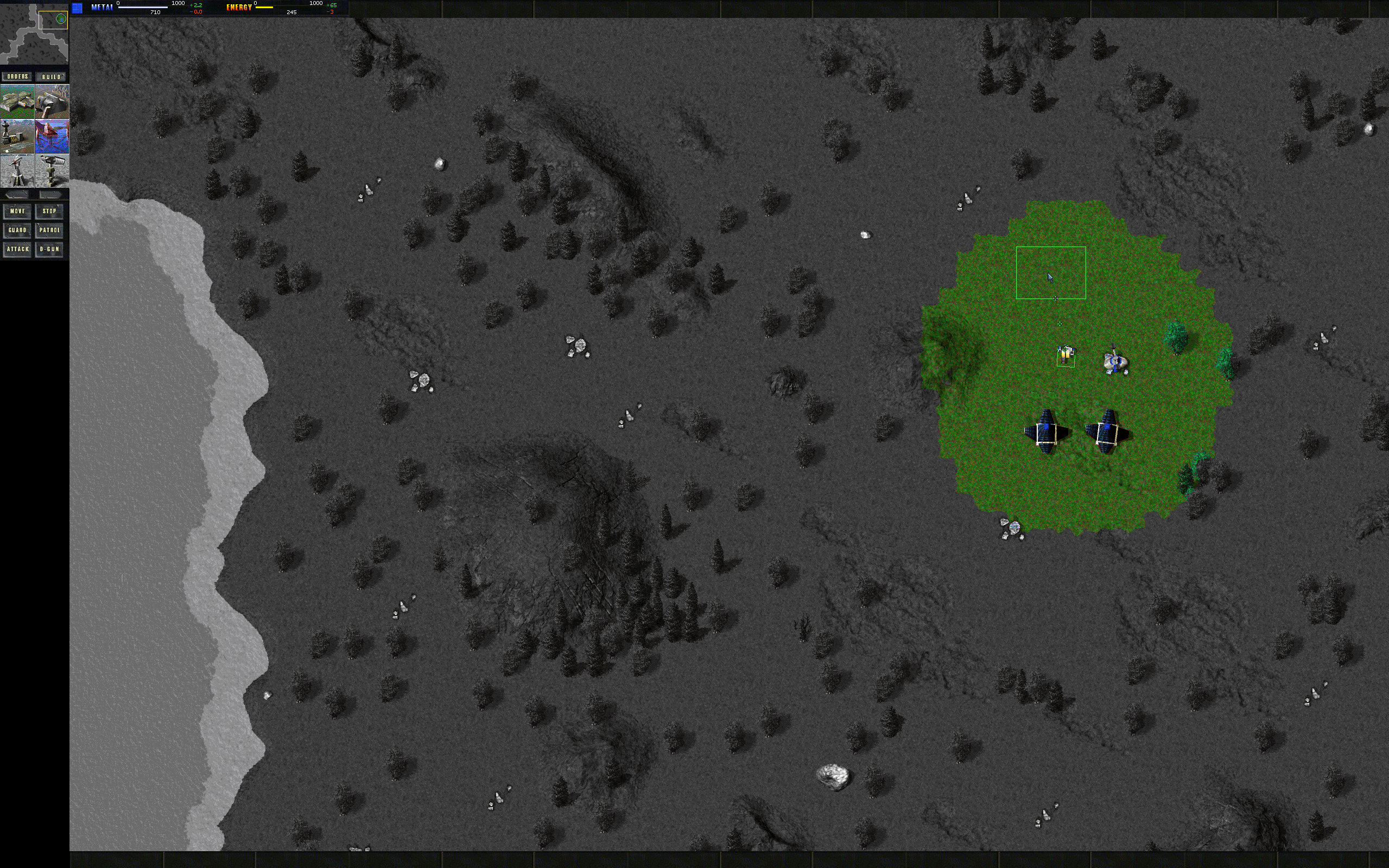
What makes Total Annihilation particularly special is that (depending on your modern setup and trouble shooting skills) you can get the game playing at crazy high resolutions and the game runs fine.
Total Annihilation at 2500x1600
Now, a word of warning – if you’re a PC novice, Total Annihilation won’t be for you. It’s a serious RTS and, depending on your setup, we are talking about a game developed 14 years ago when DirectX 3 was state of the art. Running it in a window has had good success for me on my Windows 7 64-bit desktop.
If you try to run it full-screen at a very high resolution you can end up with a goofy color mess of it. Anything beyond 1024x768 in full screen can be a crap shoot but if you run it windowed, you can go nuts. Back in 1997, anything beyond 1024x768 probably seemed like science fiction. The fact it will run at 2500x1600 is just…wow.