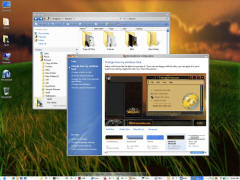
Windows Vista users already make up 5% of traffic
Windows Vista has gone from being 1% of traffic of WinCustomize.com last week to over 5% on January 30th -- the official release date of Windows Vista.
Any bets on where it'll be next week?
Windows Vista has gone from being 1% of traffic of WinCustomize.com last week to over 5% on January 30th -- the official release date of Windows Vista.
Any bets on where it'll be next week?

Windows Vista has come out. And I have to say, I really like it. Should you switch to it right away? No. I can't recommend it yet until the video driver situation is ironed out.
But down the line there are a number of pretty nice things in it that I think people will want to take a close look at.
Here's 5 reasons I think Windows Vista will appeal to gamers in the longer term or at least once the video driver situation is sorted out (if you're a gamer, WAIT a little bit until the video driver situation is good or you may find your favorite games don't run well):
#1 Windows Vista comes with included, standardized performance benchmarking.
So Vista literally gives your PC a score in all kinds of categories (CPU, Hard disk, video).
As a result, imagine games in 2 years coming with their requirements listing what your performance ratings have to be instead of vague requirements we have today. We'll also have a standard way to know just how resource intensive a game is.
My system rating is 4.0 for instance.
#2 The Games Explorer. This is a thing that lets people easily manage all the games on their machine from a nice big friendly, Media-Center like console (though not nearly as nice yet but I think this is the direction they're taking). So a PC box with Vista could be mor eeasily used as a set-top box for gaming.
#3 Parental Controls. Games that are Vista compliant include their ESRB rating. If parental controls is enabled, only games with the proper ESRB ratings can be played on the machine (and ones that don't comply get exluded entirely -- it will be interesting to see how this works out).
#4 DirectX 10
#5 Better casual games. The 3D desktop has the advantage that you can do fancier things in little desktop type games. Plus, Vista comes with several casual games.
While Windows Vista doesn't have much impact on what Stardock's developing (GalCiv II supports Windows 98), there are certainly a lot of nice features that we think will maek Windows Vista a better experience for gamers down the line.
Some of you may have been reading the recent articles in PC World, MSNBC, and elsewhere about how you can use parts of Object Desktop (such as WindowBlinds) to make Windows XP feel a lot like Windows Vista.
Today, Stardock has rolled out its plans for Windows Vista. Consider how much Stardock's software can transform Windows XP to make it not just "prettier" but more functional, one can imagine what Windows Vista makes possible. Now, a more definitive road-map is available.
Check it out!
ActiveWin.com's Andre Da Costa along with Byron Hinson and Fernando Fhualpa have taken an exhaustive look at Windows Vista Ultimate.
This is, so far, the most comprehensive review we've seen for Windows Vista yet. Everything you might want to know is in here. Check it out.
Microsoft officially introduced the world to Windows Vista today. Windows Vista is Microsoft's next generation operating system to replace Windows XP.
At the launch today (see video here), the major features of Windows Vista were demonstrated. One feature we here at Stardock are particularly proud of being part of is the Ultimate Extra called Windows DreamScene. DreamScene allows users to play high-definition video content as their animated wallpaper. Microsoft selected Stardock Design (official announcement coming soon) to create content for it including the one they demonstrated at the launch.
Stardock also has developed software for Windows DreamScene that extends the feature set even further -- to support dynamic content as well as a new format specifically for animated wallpapers (.dream files). The new program is called Stardock DeskScapes and will be released shortly.
Windows DreamScene is scheduled to be available for Windows Vista Ultimate Extras as a technology preview soon after the Windows Vista Launch with it generally available to Windows Vista Ultimate Users as an Ultimate Extra later.
WinCustomize.com is the site Microsoft is sending users to obtain additional animated wallpaper content including "Evening Dream" which is what was shown at the launch (and will be available exclusively at WinCustomize.com). Users of Stardock Object Desktop will get the first crack to use Stardock DeskScapes.
More to come.
Microsoft Launch Video
Stardock DeskScapes home page
Stardock's Windows Vista road-map
Microsoft officially introduced the world to Windows Vista today. Windows Vista is Microsoft's next generation operating system to replace Windows XP.
At the launch today (see video here), the major features of Windows Vista were demonstrated. One feature we here at Stardock are particularly proud of being part of is the Ultimate Extra called Windows DreamScene. DreamScene allows users to play high-definition video content as their animated wallpaper. Microsoft selected Stardock Design (official announcement coming soon) to create content for it including the one they demonstrated at the launch.
Stardock also has developed software for Windows DreamScene that extends the feature set even further -- to support dynamic content as well as a new format specifically for animated wallpapers (.dream files). The new program is called Stardock DeskScapes and will be released shortly.
Windows DreamScene is scheduled to be available for Windows Vista Ultimate Extras as a technology preview shortly after the Windows Vista Launch.
WinCustomize.com is the site Microsoft is sending users to obtain additional animated wallpaper content including "Evening Dream" which is what was shown at the launch (and will be available exclusively at WinCustomize.com). Users of Stardock Object Desktop will get the first crack at using Stardock DeskScapes.
More to come.
Microsoft Launch Video
Stardock DeskScapes home page
Stardock's Windows Vista road-map
Windows Vista has finally arrived! Many people have been asking us what are Stardock's plans? What can we do to take an excellent new OS like Windows Vista and make it better?
There have been a lot of articles on how users of Windows XP can get a lot of the visual benefits of Windows Vista using Stardock Object Desktop. And while that may be true, Windows Vista provides us a whole new canvas of cool things we can do.
If you have Object Desktop already and Windows Vista, you can now change the way your Windows Vista logon looks with LogonStudio Vista.
We've developed a new format (.logonvista). While existing .logonxp files won't work on Windows Vista due to the significant change in the way logons are displayed, I have a feeling there will be no shortage of logons being made for Windows Vista.
LogonStudio Vista will be available for free when it's finished. If you want it now, you'll need to get Object Desktop.
Availability: NOW for Object Desktop users.
Windows Vista's new look -- Aero, looks awesome. I like it a lot. But I also like to personalize my UI to look how I want it to look. Luckily you can -- with WindowBlinds 5.5.
With thousands of different visual styles to skin the look and feel of Windows Vista, along with the ability to change color, saturation, and all kinds of other elements, Windows Vista users will be able to make Windows Vista look however they want it to look.
And for power users -- WindowBlinds cuts battery consumption over Windows Vista Aero significantly. On our internal tests, running Vista with a WindowBlinds skin gave back over 40 minutes of battery life on a Dell laptop. You can test for yourself, it's pretty consistent. And if that's not enough, WindowBlinds is faster too thanks to DWM caching.
Availability: NOW for Object Desktop users (in beta). Public release, February 5th.
If you have Windows Vista Ultimate, you will be able to get Microsoft's new animated wallpaper extra called Windows DreamScene. It lets you play video as animated wallpaper. If you like the computer generated animated wallpaper that comes with it, then good, we made it, including the one shown at launch and the default official one (animated Aurora).
Object Desktop users will be able to get exclusive animated wallpapers not available anywhere else. And they'll be getting our new program that lets Windows Vista Ultimate users have dynamic animated wallpaper. Dynamic animated wallpaper is generated on the fly and it's all done on the video card so even on a mid-powerful computing rig, you'll see virtually no CPU use and incredibly cool stuff.
Moreover, it supports a new format we've designed called .dream. Amongst the various features it supports, one really straight forward one we think artists will enjoy -- credit. Look at the screenshot on the right and you'll see that we've extended the wallpaper dialog to support author info (which can be a link to a website). Creating a good animated wallpaper is non-trivial and we figured artists would want to make sure their hard work gets credit and send them traffic.
Availability: As soon as Microsoft releases Windows DreamScene for Object Desktop users.
Windows Vista includes the Sidebar. That's good. Making sidebar gadgets is not particularly easy. That's bad. But sidebar gadgets provide a standard format. That's good. But the native functionality of the Sidebar gadget APIs is painfully low. That's bad.
Enter: DesktopX 3.5. Nearly ready for beta, DesktopX allows users to export their creations as Windows Sidebar gadgets! This is significant because of the massive functionality and API support built natively into DesktopX. From a technological point of view, it's a superset of every widget/gadget implementation out there. With 8 years of development behind DesktopX and thousands of widgets, objects, and gadgets out there, it provides a huge boost to Windows Sidebar gadgets and a great way for users to be introduced to the power of DesktopX.
Because DesktopX doesn't just make gadgets, you can build desktops (we even make an enterprise version of DesktopX for corporations wanting to create secure branded desktop environments).
Stardock also has developed a technology that allows users to create gadgets in .NET (including WPF gadgets). We'll be talking more about that soon.
Availability: Late February Beta for Object Desktop users
Changing the icons for Windows Vista is not quite as easy as previous OSes. For one thing, the folders are done differently -- they have "live previews". But no worry, we've got that nailed down now and you can now even change the live folder preview icons and still get live previews!
Availability: Early February in beta on Object Desktop.
Stardock BootSkin allows users of Windows XP to change their boot screens. So what about Windows Vista users? On Windows Vista, the default is not boot screen at all! With BootSkin Vista, you'll be able to have your own high-resolution, high color boot screen of your choice.
Like BootSkin for Windows XP, when completed it'll be released as freeware. But the initial beta will be on Object Desktop only.
Availability: Mid March for beta on Object Desktop.
We've partnered up with TweakVista.com to bring you a new program called TweakVista. Designed both for power users and their friends and family, TweakVista lets users get into the guts of Windows Vista but also allows casual users to maintain their systems.
Many people reading this are probably the family "computer guy". If you are, you'll definitely want TweakVista to hand out to people because it helps take care of the most common problems people run into with a Windows PC. But it also lets you dig into the guts of Vista to change undocumented settings and get more data on your system than..well probably more data than you really need to know. 
Availability: Mid March beta.
If you have ObjectDock 1.5, you have the version that already runs on Windows Vista. But the good news is that we are busy at work on the next version of ObjectDock which is due out later this year. If you don't have ObjectDock (particularly ObjectDock Plus) grab it! You can get ObjectDock right now at www.objectdock.com.
Availability: Summer
CursorXP is the defacto alternative to the Windows XP mouse cursors. On Windows Vista, CursorVista is being designed to make it even more powerful. Thanks to the new DWM (the composited, 3D surface that is the Windows Vista desktop), all kinds of fun should be possible. We are getting fairly close to having a beta of this available. If you have Windows XP, you can get CursorXP at www.cursorxp.com
Availability: Early Spring
Working on stuff that's about to get released is very exciting. But the stuff that's just getting cooked up in the labs is just as exciting. When Windows Vista's RTM build was sent to us, we were able to start digging in and seeing what's possible. As video driver quality gets better and we get a handle on what parts of Windows are more easily extended than others, cool stuff results.
My #1 reason I like Windows Vista in terms of customization is that it's free from a CPU point of view. Now that the desktop is a 3D surface, we can do all kinds of cool stuff without affecting system performance.
For instance, Microsoft's Windows DreamScene plays video as your wallpaper. Now, I've seen people say "You could do animated wallpaper on Windows with <insert hack here>." Please. What is possible and what is practical are two different things. The only CPU used by DreamScene is in the decoding of video which is not a major deal now adays. Other effects are completely done on the video card.
On Windows XP, we had to develop a DirectX interface ourselves to get universally good performance with this stuff (which people noticed in WindowBlinds 5). But on Vista, everything's already on the video card, it's great!
With Microsoft providing a standard gadget format, Stardock can then concentrate its resources into what it does best -- making really cool technology. Not a competitor to DesktopX, DesktopVista is designed to enable the creation skinnable gadgets. That is, a system in which a standard gadget skin format can be created and used to skin gadgets. Right now, it's just a technology.
Windows Vista is pretty polished. But it could be polished further. Enter StyleVista. This new program will let users alter the little touches that Microsoft has in Windows Vista that don't quite fit into skinning but also are just beyond what is included. Want a different blur effect? Want to change that Start button? StyleVista is for you. We're still inventorying what we can and can't do with the DWM now that finalized video drivers are coming out so we'll have more news on this soon.
For years, a significant percentage of artists were locked out of customization. 3D modelers might be able to make pretty rendered icons but beyond that, things were limited. But now, thanks to a combination of Windows Presentation Foundation (WPF) and Media Center Markup Language (MCML) we are exploring letting users take their 3D creations from Maya, 3D Studio (and if possible XAML) and turn them into working, fucntional 3D desktops. Not 3D in the sense that you move around the screen but rather where the objects you interact with are 3D.
What we can and can't do will heavily depend on the capabilities of WPF/MCML and the DWM which we're still exploring (as well as video drivers). We hope to have something to show late summer.
People on Linux have been showing off XGL for awhile. Anyone with Windows XP should try out WindowFX and know we've been doing window scaling, 3D dragging of windows, and all kinds of effects since Windows XP launched and we didn't have the benefit of a 3D accelerated desktop. Now we do. That's all I'm going to say on that.
It's going to be an exciting year! Stay tuned!

Previously (part 1, part 2) we have discussed that the amount of money professionals make has to do with the value associated with the task they are assigned to complete. The greater the value and the more of that task the person is responsible for, the more that person will make. The easiest way to increase your value, therefore, is to increase your skill set such that you can accomplish those tasks more quickly and take responsibility for greater parts of it.
If it takes 5 people to accomplish a given task and you are one of those 5 people, your salary is going to be split amongst those people. If you can learn skills that allow you to take responsibility for 2 of the 5 parts of the task, your value increases accordingly which will, in time, be returned in the form of higher salaries and bonuses (and if not, you should find a better company to work at).
Entrepreneurs are often people who can accomplish a valuable task largely on their own. The small businesses they create tend to stay that way because taking it to the next step requires a very different set of skills -- the art of managing people. The reason to hire more people is so that more valuable tasks can be accomplished or that tasks can be accomplished more quickly. The catch is that the capability of individuals varies by up to a factor of 100. That variance is largely due to poor work habits (poor time management, disorganized, or laziness). As a result, the fledgling manager may hire 4 people only to discover that not only are they not accomplishing more tasks, they aren't accomplishing the previous tasks as quickly as the fledgling manager used to be able to do on their own. It is at this point that poor managers and good managers are separated from one another.
Good managers focus on accomplishing tasks and recognize that their team exists solely to accomplish that task. And different members of that team will contribute to the completion of a given task at different rates based on their capability.
You've just become a manager. And you've got 4 people working under you to accomplish task A. Turns out though, that those 4 people have very different capabilities. Sally has good capability but poor time management skills -- she chit chats a lot and as a result isn't as effective as she could be. Ted is a super worker. Heck, he could practically do the whole project himself. You can "fire and forget" with him. Bill, meanwhile, is incompetent. He just doesn't know what he's doing and won't venture outside his limited skill area. And Jon is just lazy. He'll do a little work, then spend his time on instant messaging or surfing the net.
The net result is that task A actually only gets done as quickly as you could have done it on your own. And the only reason it's only doing as well as it did is that you lucked out and got Ted who is not only doing all he has to do but is picking up the slack left by his friend Bill.
A bad manager might just be tempted to throw more and more on Ted. It's the easiest thing to do -- just assign Ted to almost everything and have Sally, Bill, and Jon do marginal pieces. Besides being unfair, it's economically infeasible. Because if Ted is responsible for 70% of the work and Sally, Bill, and Jon are picking up the remaining 30%, is Ted being paid 7 times as much as Bill and Jon? Probably not. Eventually, Ted is going to find a new job (or be promoted elsewhere).
So what should the manager do in the above scenario? In my experience, the first step is to identify whether Sally, Bill, and Jon are salvageable. Odds are, at least 2 of the 3 of them are with the right manager. But the manager has to decide whether his time is best used increasing the capability of his team or doing some of it himself.
Now you've had some time to look at your team and realize that the task is not getting done as quickly or well as it should be. Sally's slow because she wastes time on other tasks (socializing, or worrying about minutia). Her issue is one of motivation and inspiration. Good managers know how to motivate people and inspire them to focus on what needs to get done. So you talk to her about the tasks at hand and how she can better use her time to help move things forward not just for the sake of the project but to help herself as well. Result - she improves.
Bill's still incompetent but he's at least trying harder now and you've spent some time training him to increase his productivity. Unfortunately, you still have to check Bill's work because it's spotty. Sometimes he gets it right, sometimes he doesn't and it's seemingly at random. You'll have to evaluate whether Bill is worth keeping -- the time you're spending on training him is time you could be using to improve others who are much more productive (a 10% increase in the mega guy is worth more than a 50% improvement than someone who's barely functional). But into that evaluation you'll have to include morale overall of firing people and the fact that Ted, your best worker, is good friends with Bill.
And Jon is just lazy and you decide to fire him. And to improve the performance of your team, you spend some of your time on the project directly. Net result, task A is now completed 2.5X as fast as you could have done it alone. Of course, it now takes 4 people to do that task. Is it worth it? Depends on how much your team costs. That's another factor that many workers don't realize -- the more you're paid, the more you have to produce. Bill's survival on the team will likely depend on how much he's making.
Eventually you'll get a feel for when you need to do a given task (or sub-task) yourself and when to assign a subordinate. And you'll get a feel for when it makes sense to improve one of your workers versus when it makes sense to terminate them outright. But it takes time and experience. There is really no substitute for experience. It's an intelligence multiplied by time kind of thing. Even Bill Gates learned, the hard way, that you can't just take productive workers and turn them into managers. It takes a real skill to it and few people are truly good at it which is why they tend to make more money.
Managers don't necessarily make more than workers though. Some managers resent this but only because they either forgot or don't understand that it's about getting the task done. In the above example, imagine if you terminated Jon but lacked the skills necessary to work on the task yourself but instead had to rely more on your super-guy Ted. Well guess what? Ted is eventually going to make more money than you because his contribution to the completion of task A will be greater than yours. Managers have an inherent advantage in contributing the most to the completion of a task because they make the assignments, but that doesn't guarantee that the manager is going to be the one who actually contributes the most to the completion of a task.
Next we'll take it to the next logical progression -- the management of managers!
Stardock LogonStudio for Windows Vista has gone into beta for users of Object Desktop. LogonStudio is a program that enables users to replace the Windows Vista logon screen with one of their own creation or use one made by others. The new .logonvista format has been designed to be extensible so that as Stardock adds more features to the format, existing logons will continue to work.
We have created a new gallery on WinCustomize.com to support these new logons. Taking screenshots is a bit of a challenge since print-screen doesn't work when you're at the logon prompt in Windows Vista but Stardock plans to add support for making screenshot previews in an upcoming build.
If you don't have Object Desktop, now's a good time to get it. Object Desktop is Stardock's premiere suite of desktop enhancement utilities that includes WindowBlinds, IconPackager, DesktopX, ObjectBar, RightClick, SkinStudio, and many other programs that can completely transform the Windows desktop to your own design. LogonStudio Vista is the first of the Windows Vista specific programs released (users of Windows XP have LogonStudio XP already).
LogonStudio Vista Gallery (use THIS gallery for Vista logons, not the XP one)
Screenshots:
Last time, I talked about how individuals, especially those starting out, could earn more money from their jobs in a professional environment. And it boiled down to learning as many skills necessary to accomplish valuable tasks as efficently as possible.
The older I get, the more apparent it becomes that there are huge gulfs in capability between individuals. We're not talking like one person is twice as capable as another. We're talking about one person being 100 times more capable than another.
At some point, the up and coming professional will hit a brick wall on how much they can earn going it alone. They'll need help in order to either accomplish more valuable/complex tasks or accomplish more tasks total.
The more people you need to accomplish a task, the less you'll make from each task. Therefore, you bring on more people only if that enables you to get a lot more tasks done or accomplish more valuable tasks. If this is the case, you're about to become a manager.
Unfortunately, most people can't even accomplish the part of the task they're responsible for. The three most common reasons people fail to accomplish their specified tasks are:
Poor time management (they blow away gobs of time on lesser important things)
Poor organization (they forget to do some piece of it)
Laziness (they just don't want to work on things that aren't fun)
I'd say 75% of people have one of these 3 issues. The good news is that items 1 and 2 can be addressed by having a good manager or mentor. The last issue is probably terminal. But these are obstacles that managers will have to deal with.
Many entrepreneurs never move beyond targeting tasks that they do almost completely by themselves. Many more entrepreneurs attempt to become managers, discover that it's actually taking longer to accomplish the same tasks even though there's more people working on it, and give up.
What seperates a typical manager from a good manager is the ability to get your team to accomplish those tasks significantly faster than you could have done it yourself. And that's no easy thing because, like I said, there can be a 100X difference between the capability of one person and another.
Moving from being an individual agent of good task completion efficiency to being a manager can be very challenging. Below is the example of what I went through.
|
Example: The Software Developer as Entrepreneur Example Once upon a time, I decided to make my career being a software developer in business for myself. The skills I had to learn included:
This is obviously not a complete list but gives you an idea. If I had had venture capital, I might have been tempted to just hire people to do some of these things. Maybe the same task could have been accomplished in a VC funded company if I had a Business Manager, A Web Designer, a Graphics Designer, and of course me to write the software. Had I done so, my piece of the task would have been smaller and hence my value decreased. Therefore, the only justification to have hired those people would have been if the value of the task were increased by the corresponding amount OR I could accomplish a lot more tasks. Sometimes that is the case. Sometimes it's not. Companies live and die based on those kinds of decisions. In my case, once I felt the company had reached a certain level, I put my efforts into learning a new set of skills -- the art of managing people. In this way, I could accomplish a lot more tasks. So while my % of a given task that was mine went down, I could accomplish a lot more tasks. |
So now you're a manager. And now your relationship with the task may look something like this:
Now that other people are involved, your piece of the task is that much less. Therefore, that task needs to be correspondingly more valuable or you need to accomplish more tasks.
So now all you have to do is tell people what to do right? Wrong. Many managers will wrongly assume that managing is just giving people assignments and having big ideas that they then delegate out to others to do. In corporate America, many managers do just that. But that will limit how far they can go.
The typical new manager will quickly discover that without learning management skills, they not only won't be able to accomplish more tasks, they won't even be able to accomplish the tasks they used to be able to do on their own in the same amount of time. More people can actually slow things down.
That's because those people may be 1/100th as capable as you. Even if they're 1/5th as capable as you, if there's only 4 of them and you've switched from doing the task yourself to assigning others to do the task, you've lost ground.
A good manager will then need to decide carefully when they should focus their attention on improving the capability of their team versus simply accomplishing more of the task directly themselves. It's a tough balancing act. Do too much yourself and you've lost any benefit from having a team. Spend all your time trying to get less capable employees to be more effective and your tasks don't get complete.
What's worse for the super-manager (which we'll talk to in the next section), not only are 75% of workers inefficient due to the 3 issues we talked about earlier, 75% of managers have those same issues and were simply promoted because of things like seniority or politics, or because they were really good at accomplishing specific tasks but have no capability as managers.
To be an effective manager, the first step is to make sure you yourself can clean up any issues that make you less effective (poor time management, poor organizational skills, or laziness). Only then will you have a chance at maximizing the efficiency of your workers. And I stress the word chance because odds are, if 3 out of 4 of your workers has efficiency issues, only an unknowable % of them can be cured. Some will have to be fired and some will have to simply be managed as best they can.
The truly good managers recognize that their job isn't managing people. It's accomplishing tasks. The people represent make up the team that exists solely to accomplish that task.
The good manager works with their people to increase the effectiveness of individual members but also will choose to accomplish parts of the task directly if the effectiveness of their people is lacking sufficiently to justify going in.
A good manager does the math: The sum of the members of the team (and their corresponding cost) must exceed the native capability of the manager or else the task is not going to be done as well as it should. The manager needs to make sure the members of the team either are effective, eliminated, or bypassed.
Put another way, the good manager is focusing on the best way to accomplish the task, recognizing that some of them may be incompetent to varying degrees. Sometimes the manager simply doesn't have someone on their team who can even accomplish a crucial part of the task.
The successful manager therefore has to know when to put their energy on improving the performance of their team, when to eliminate a member of the team, and when to simply do part of the task directly in order to get it done.
Next, we'll talk about how to get those tasks done and how to take things to the next step.