Brad Wardell's Blog


The evolution of the Drengin

Published on Friday, November 22, 2013 By Brad Wardell In GalCiv III Dev Journals

Many years ago, when I was trying to come up with a villain for what I called, at the time, Earth Space Wars, I wanted an enemy that was brutal, ruthless and most importantly, inhuman. An enemy that would look at our system of ethics, morals and honor and laugh at them as being hopelessly naïve and primitive.

Below are images of the Drengin over the years.

image

Early Drengin image from early 90s.

image

Drengin painting from 1995

image

Lord Kona, Galactic Civilizations I

image

Lord Kona, a few years later in Galactic Civilizations II

Diplomacy_Temp_UI

Early GalCiv III version of Kona where he was blended with Korath concepts.

image

Elderly Kona

Speakout Meet the Parent

Published on Thursday, November 21, 2013 By Brad Wardell In PC Gaming

I’m putting this up so that it’s not lost to time.  This is an article I wrote for Computer Games Magazine about my son playing World of Warcraft back when he was 8 years old and how he played it differently from adults.

image

The power of the malicious anonymous user

Published on Monday, November 18, 2013 By Brad Wardell In Everything Else

Listen to this, it’s worth it

A good friend of mine sent me a link to this episode of “The Moth”: http://themoth.org/posts/stories/anonymous

It’s about a popular teacher who nearly saw his career ruined by hateful, anonymous rivals who took snippets from his blog to paint a horrible, completely inaccurate picture of him.  It illustrates the disproportionate power of cowardly, anonymous people have to inflict harm on others.

The power of malice

I can relate to this in a very personal way.  Not a week goes by where someone doesn’t take a snippet from something I’ve written and uses it to smear me in a very personal way.  I’ve been blogging since 2001 and posting on forums for much longer.  As you can imagine, I’ve got thousands of writings out there and if you are willing to sift through them and cherry pick you can probably put something together that sounds horrible. 

The power of narrative

The Internet makes us all into empty vessels that people pour their hopes and dreams or their bile and venom into.  I’ve been both kinds of vessels during my career and neither one remotely resembles reality.  Once a narrative gets started, it’s difficult to change its course. It is easy to become a passenger on the narrative that ultimately forms your reputation – for good or ill.

WindowBlinds 15 years in pictures

Published on Wednesday, November 13, 2013 By Brad Wardell In OS Customization


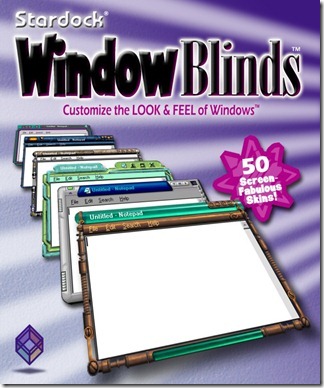
WindowBlinds 1.0 was released in November 1998! Since then, it’s gotten over 100 MILLION downloads!  Over on CNET’s Download.com version 8 has received over 18 million downloads. 

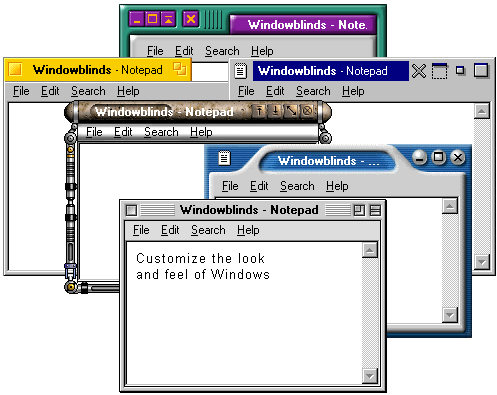
It was the first program to enable users to customize the look and feel of the Windows GUI.  15 years later it is still going strong. Let’s take a look at its evolution in pictures.

Version 1

Changed window frames, menu bars.
collage


neoplanet

holiday

od2001

ui99

Yea, this was the config UI we had..cough..


Version 2


Adds per-window skinning, semi-transparent explorer windows, skin colorizing

odnt-april99

lightshot

Desktop light sourcing

wbbox

WindowBlinds gets into retail!

skins-aug99

WindowBlinds used to send data back to us on what skins people had. We took this out because users were unhappy about their “privacy” (anonymous data being sent). Seems quaint now.
wb20

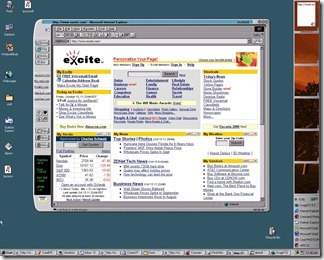
WindowBlinds skins supported adding buttons and other objects into the frames (such as this stock ticker).
wb-nov99c

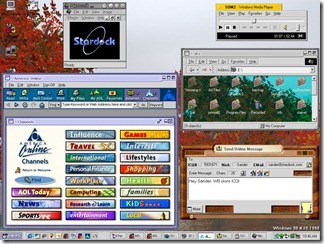
Remember AOL? Their client was a huge pain the skin correctly. Also, look at the BeOS skin.

wb-jun00

wb-aqua

MacOS’s “Aqua” look for its newly launched MacOS X helped make WindowBlinds incredibly popular for Windows users who suddenly recognized how ugly Windows NT/2000 were.

wb-apr00a

In fact, making Windows look like other, less ugly, OSes was a big deal.


Version 3

Designed with Windows XP in mind, 3.0 was the first version that could skin every part of the Windows GUI. The competition had stiffened as Microsoft had released uxtheme.dll that, once hacked, allowed people to create GUI skins freely. WindowBlinds thus had to provide significant value-add to justify $20.
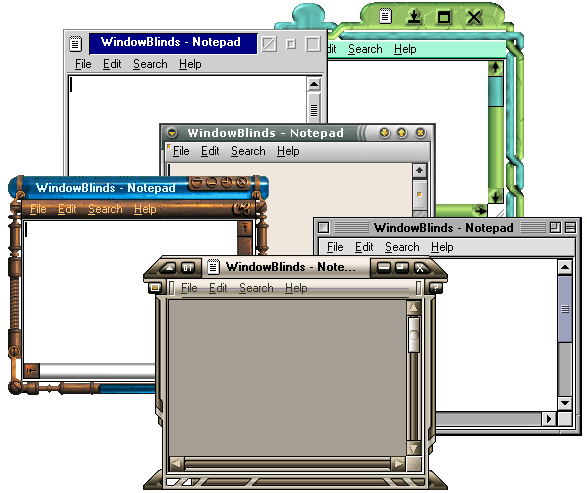
kmk

wb-mar02

The quality of the skins had to really go up to compete with the bland but free uxtheme skins.

wb-apr02

Third-parties began licensing WindowBlinds for marketing purposes (Nvidia here)

wb-nintendo2

(Nintendo)

wb-sept03

(The Microsoft XBox team here – one wonders what the Windows team felt about this at the time)


image

Sometiems it was just a matter of making Windows XP look a bit nicer than Windows XP defaulted to.

image

Other times it was about reminding power users just how gimped the Windows XP “Luna” UI made Windows.


Version 4

Version 4 was the point where WindowBlinds “won” the contest versus uxtheme.dll in that it could not only do everything it could do and more but version 4 made use of DirectX draw acceleration to make WindowBlinds substantially faster (i.e. noticeably faster) than using Windows XP without it.

However, this popularity would come at a price – the quality of the average skin submitted became substantially lower. WindowBlinds skins acquired the reputation for being ugly, gaudy, fat.


wb-jan04

WindowBlinds 4 added a lot of neat controls for controlling how coloring worked. 

wb-jan05

wb-dec04

wb4


Version 5

The era of Aero had arrived. Microsoft was finally taking the aesthetics of Windows seriously and created a new glassy looking UI called Aero.  WindowBlinds 5 was designed to support per-pixel alpha blending, toolbar button changing, progress animation improvements, animated per-pixel Start menus, title bars, etc.

wb-nov05

Aero all the time

wb5-3[1]

Our own take on Aero

However, the problem Stardock and its community faced was that a “complete” skin was a significant amount of labor. Thus, a lot of the most talented skinners began finding other things to spend their time on. It wasn’t “fun” anymore.

wb-jan08


Version 6

WindowBlinds 6 added the ability to apply effects such as Gaussian blurs to skins in real-time. However, the biggest change came in the new configuration because it was becoming clear that the number of high quality new skins was dwindling (while the user base continued to increase). The new config allowed end users to heavily modify their skin library.

image

That dragon is fully animated and so is the title bar.

image

The new config allowed users to do all kinds of crazy things to their skins and then save them as a sub-style

image

The official World of Warcraft skin got a second life with WindowBlinds 6
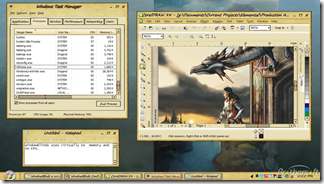
image

The Elemental skin for WindowBlinds 6


Version 7

It is with some irony that WindowBlinds 7 was ready in time for Windows 7 (the versions being the same was coincidence).  WindowBlinds 7 introduced a new type of skinning format called UIS0 which allowed users to just modify the existing Aero skin.  This made WindowBlinds a lot more popular for people who liked Aero but wanted a bit nicer look and feel to it.
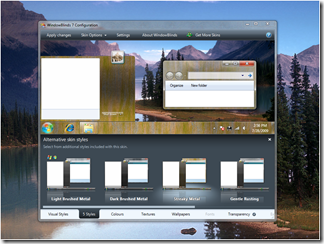
image

A new, simpler and just as powerful config window.

image

Stardock began contracting professionals to make skins to ensure that there were some good, new, benchmark skins available.

image

Mac inspired skins remained popular

image

So with UIS0, you could apply a texture and color to the existing Windows 7 Aero making it look, imo, much nicer.


Version 8

Version 8 was mostly about getting WindowBlinds to work on Windows 8. Microsoft essentially gimped the underlying window theming system they had – they killed Aero! No Aero, no UIS0.  They replaced it with the stripped down UI seen in Windows 8 and 8.1.

image

Once again, a new and improved configuration UI.

image


BEYOND 8

WindowBlinds 8 is still very new, what but the challenge going forward is coming up with new and interesting ways to skin the Windows GUI that make it attractive for new users!  Visit www.windowblinds.net to learn more about WindowBlinds!

Comparing Sweden/Finland/Denmark vs. other countries

Published on Tuesday, November 12, 2013 By Brad Wardell In Life, the Universe and Everything

Every few weeks someone writes an article comparing some amazing statistic from the Nordic countries in Europe and then compares that statistic to the United States in total.  It’s always some ridiculous apples and oranges comparison that results in a meaningless comparison.

So just as a reminder, the populations of these countries are:

  • Sweden: 9.5 million
  • Denmark: 5.6 million
  • Finland: 5.4 million
  • Norway: 5 million

In addition, demographically and culturally they are relatively homogenous.

By contrast, the United States has a population of 314 million. 

Next time you see someone playing the stats game with a Nordic vs. USA make it a bit more relevant.

Let’s use a US state that is similar to Nordic countries like say Massachusetts: Population 6.7 million.

  Mass Sweden
Population 6.7m 9.5m
White 84% ~98%
Lifespan 80.1 81.2
GDP per capita $58,108 $57,297
Incarceration rate per 100k 218 67
Dominant Religion Catholic 44% Evangelical Lutheran: 94%
Mean income per person $33,966 $21,1193

Now, I picked Massachusetts originally because it has some similar basic demographics (population and culture).  Though, as you can see even here, while Massachusetts is relatively homogenous for a US state, it can’t touch Sweden.

None of this is meant to make one look better than the other. In fact, the chart above makes it clear that both have their own strengths.  The point is that when someone tries to compare a homogenous nation state with a population of that of a smallish US state with the entire United States, put on your skeptics hat on.

Stardock Status Report: November 2013

Published on Friday, November 8, 2013 By Brad Wardell In Stardockians

I haven’t done one of these in a while but holy cow so many cool things going on with so many things being announced so recently that I think we owe it to you guys to share what’s happening here.

So as some of you know, Stardock’s an “indie” in the sense that it’s still owned and run by its founder (me). So there is no question whatsoever who I am responsible to: My coworkers and you.  I don’t have stock holders to please and that lets us do lots of new and interesting stuff.  So let’s talk about it.


Oxide

image2 weeks ago we announced Oxide Games (www.oxidegames.com). Oxide is an independent studio that is dedicated to making cool and interesting technology and games.  It has a bunch of things it’s already working on but the one that has gotten the most attention is the Nitrous 3D engine.  It is the first (as far as I know) engine to use SWARM (Simultaneous Work and Rendering Model) or anything similar. What SWARM means is that graphics are processed completely concurrently with your cores. The more cores you have, the faster it runs. The engine has no concept of a “main” thread or a “graphics” thread or what have you. 

SWARM

From a developer’s perspective, it has the ease of writing a “single threaded” game while the engine just splits everything up between the various CPU cores. SWARM matters because the much of the eventual improvement in visual fidelity in PC and the new-gen consoles will come down to making use of all those cores and the Nitrous engine makes full use of them.

MANTLE

Another piece of news that’s actually a pretty big deal for PC gamers (and those who own any consoles that happen to be powered by AMD – like Xbox One and PS4) is Mantle. This is AMD’s competitor to DirectX. There’s no sugar coating it. Mantle is as much an alternative to DirectX as OpenGL is.  And I can tell you, it’s pretty amazing and Oxide is supporting it (see AMD’s press release).

CRAZY GRAPHICS

What all this will mean for games is that you will be able to have games with the visual fidelity of movies.  Let me be specific: Remember the beginning of Revenge of the Sith with that massive space battle? We can do that now. Same level of visual quality at >30fps.  Or remember the battles in Lord of the Rings? Same thing. The hardware and with Nitrous, the software has reached the point where those CGI scenes can be done in real-time.  There are games in development right now that will deliver this.

RAMIFICATIONS

One interesting side effect will be - where will gaming go after this? If the hardware and software has reached a point where we’ll start having real-time, photo-realistic scenes with thousands of things at once and uncanny valley is due only to talent limitations, what happens next? 


Stardock Plymouth

With the recently launched Mobile unit (HEY! Go get Deadman’s Draw, it’s awesome!) and with the long-stated goal of having 2 game development teams internally running at the same time, we’re building out our lower floor.  Here are some pictures:

image

This is the café we’re putting in where people will be able to eat launch, play video games, hang out. 


image

We have an in-house nutritionist that does cooking demos and so the lower floor will have a much expanded kitchen/bar area where she can teach different recipes.

Before anyone asks, we have a nutritionist because let’s face it, many people in our industry (cough…cough) eat crap.  Now that I’m in my 40s, I really regret the things I ate and I wish I knew then what I know now.  So this is one of those things we can do to help those who are interested eat healthy good food.

The kitchen on the main floor is being converted to a fitness room.  Our in-house trainer works with those interested in physically training (mostly flexibility and weight related training).  I did this because, again, now that I’m in my 40s and I can barely touch my knees due to 2 decades of sitting at a computer, I wish someone had told me or..ahem motivated me (i.e. a trainer) to take just a little time each week to stay in better shape.  It’s voluntary of course but the response has been really positive.

image

image

This is the work area downstairs where Galactic Civilizations III’s team will be moving down into. That way the So—nevermind, the OTHER team will be have most of the top floor.

Old man Paxton (Stardock’s new VP, Kael) has been pushing to expand the QA team further which means, of course, more room.  I have tried (but failed) to explain that it’s the compiler’s job to do QA. If it compiles, that means it works.  For some reason, he disagrees.

Mohawk Games

imageLike Oxide, Mohawk is an independent studio.  Like Oxide, Stardock’s roll is to provide seed capital and the business management aspects (the stuff that tends to bog down start-ups). 

When I have more time, I plan to discuss in some detail the way the Stardock Investment Fund (SIF) functions. It doesn’t just throw money at studios. SIF also provides employee services (health insurance, 401Ks, accounting, legal, and bunches of other “stuff”) and then incorporates the studios into a wider development network that allows each group to share resources.

Those of you who are familiar with the game industry know how volatile employment at these places can be.  The SIF is designed so that someone can have a career at these studios without worrying about being laid off randomly because a project ended. Instead, the studios just contract resources between each other.

Mohawk is working on an economic conquest game code-named Mars (and I can’t think of anything to usefully compare it to except MULE but this is not like MULE other than being in the same genre).


More to Come

There are a few more endeavors that are starting to get close to being announced.  We’ll be talking about those in the coming weeks/months.

739 pages 91 92 93 94 95 96 97 98 99 100 Next