Brad Wardell's Blog


Galactic Civilizations II, Copy Protection, and Piracy

Published on Saturday, March 11, 2006 By Brad Wardell In GalCiv II News

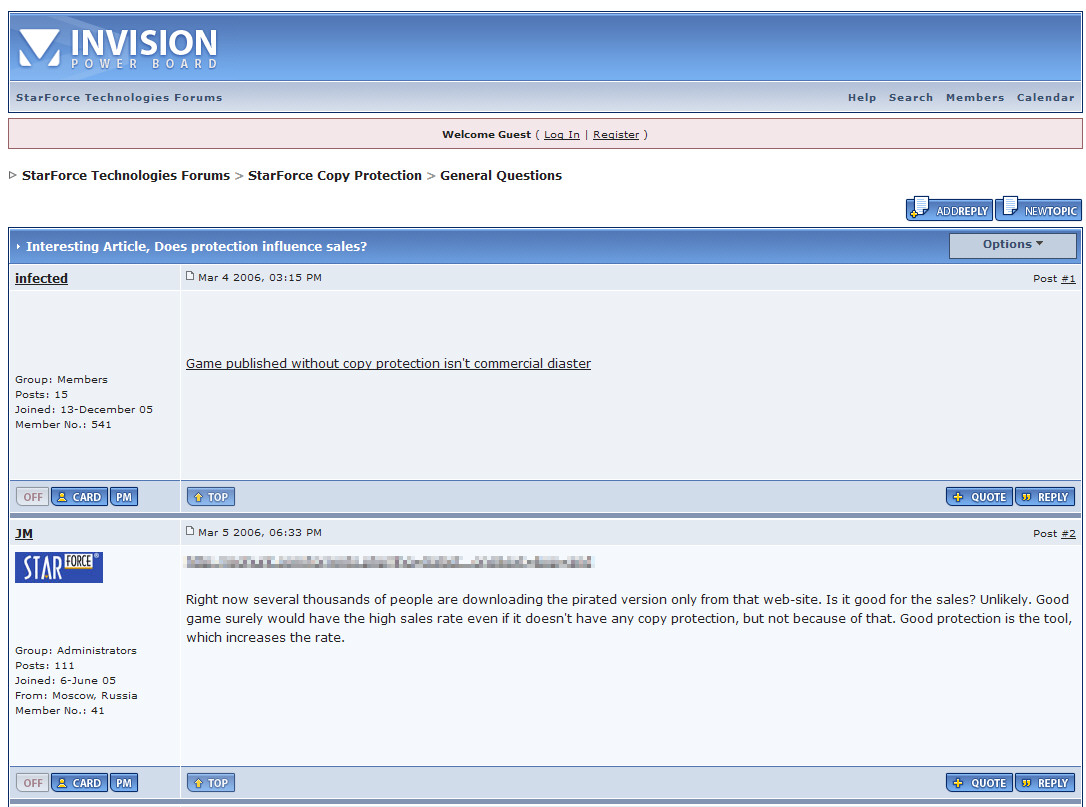
Digg is reporting that a website is implying that we want Galactic Civilizations II to be pirated.  Absolutely not! Of course we DO NOT want our game to be pirated. We're a small company, every lost sale hurts us.

This got started because sales reports on Galactic Civilizations II have been much higher than anticipated. We've now outsold the first Galactic Civilizations in North America in the first 10 days. Last week we were apparently the #1 PC game at Walmart. 

Naturally, some peple have taken the conclusion that because we don't have copy protection on our game, that we invite piracy. That is not the case, we simply think there are other ways to stop piracy than CD checks, strict DRM, etc.

What we do is provide a serial # that users can choose to enter when they install and use that unique serial # to download free and frequent updates.

Our license allows you to install the game onto as many machines that you own that you want as long as only one copy is being used at once.

How many sales are lost because people want to have a game on their laptop and desktop and don't want to drag CDs around so choose not to buy the game?

Our company also makes utility software. We've been around a long time -- 14 years now. Our software gets pirated. We don't like it but piracy is a fact of life. And not every pirated copy means a lost sale.

The question isn't about eliminating piracy, it's about increasing sales. It's about trying to make sure that people who would buy your product buy it instead of steal it. 

Our primary weapon to fight piracy is through rewarding customers through convenient, frequent, free updates.

If you make it easy for users to buy and make full use of your product or service legitimately then we believe that you'll gain more users from that convenience than you'll lose from piracy.

We realize that some people or companies might feel threatened at any evidence that implies that draconian DRM schemes or CD copy protection may not make that big of a difference in sales. 

For example, we were quite disturbed to discover that the company that makes Starforce provided a working URL to a list of pirated GalCiv II torrents. I'm not sure whether what they did was illegal or not, but it's troubling nevertheless and was totally unnecessary.

All software is pirated, there's no way around it. We've been making software for over 10 years.  We don't like our software being pirated.  Like I said, every lost sales has an impact on us.  But there are other ways to reduce it than through draconian copy protection systems.

Incidentally, the site that Starforce's forum admin linked to "prove" how much our software was being pirated we visited, followed the instructions on the site to get our game removed and the links were removed within a couple of hours.  We'll continue to follow-up with them.

Update: Starforce has removed the URL to the illegal files.

Update: View follow-up.

Implementing player suggestions

Published on Saturday, March 11, 2006 By Brad Wardell In GalCiv Journals

I've been reading a lot of discussion both here and on other sites about ideas and suggestions players have for Galactic Civilizations II.  Stardock, I like to think, is reasonably well known for implementing pretty significant changes into its software well after release.  If we think something is a really good idea and it won't dramatically change the product, we'll seriously consider implementing it.  We've been doing that since the first software products we released over 10 years ago.

Of course, the question is, what constitutes a change that is too dramatic? And how can we determine whether a given idea is something that's good for the game or not?

Before we start out there, I should make a clarification on something.  I've seen threads where people will say "Yea, but Brad says it's working as designed so he obviously thinks it's great."  That's not what I mean when I say that.  The context is important. 

As an engineer, I try to be precise as I can be with my words. That's one of the reasons I'm so wordy. What I write tends to be full of qualifications. One of the things I tend to object to strongly is when someone will take a design choice they disagree with and simply label it as a "bug".  A bug, to me, is something that is not working as designed.  Someone may not like a given feature, but if it's working as it's supposed to, it's not a bug. But that doesn't mean that we think it's the end-all be all feature.

One of the areas I want to tackle in the post release is the economic system of Galactic Civilizations II.  But I don't want to do it alone. I want to hear what other people think too.  But such discussions can be problematic.  As with any on-line discussion, disagreements will break out.  With people all around the world, many with strong opinions, you inevitably end up with some people who will state their opinions as facts. "This is how game X did it. Do it like that."  There is no single "best" solution. We all have our own ideas. What we can do, however, is build a consensus to some degree.

Economic Systems & Strategy Games

Some parts of the game I feel strongly about, other areas are open to significant change.

For example, in Galactic Civilizations II as leader of your civilization you can set your tax rate -- the money coming in from your people.  And you can set your "spend rate" which determines what % of your industrial/research capacity to make use of.  I believe that governments should be able to intentionally have deficit spending.  I believe that your financial income should not be tied to your industrial capacity. If you have the factories and labs to do it, you should be able to make full use of them regardless of your income. It's called deficit spending and it's practiced by many governments.  Your population will get angry if you go too far into debt. And right now, we have a -$500 debt ceiling. 

Having taxation and spending separate is something I'm married to. I like it.  I realize it's more complex than in some other games but of the other systems we've contemplated over the years, I think it provides the best balance between realism and simplicity.  People are free to disagree of course.  That's natural. Some % of people will not like it.  But I think most people understand it.

So let's talk about the part of the system I'm not married to -- the UI representation of it.

So you have your spend rate -- the % of your industrial capacity that you want to make use of.  Then the question is, where do you want that industrial capacity to go?  There are 3 sliders that control how that spending is funneled.  The three sliders allow you to decide how much to fund your factories and research labs.  Military and social spending goes into your factories which produce more planetary improvements and build your ships.  Research spending goes to your labs and is converted to research points that go to getting your next tech.

I don't think it's that complicated and judging from the various forums I read, most people understand how it works. But not everyone. Some people don't understand it and others just don't like it.  The group that doesn't understand it tend to be the same people who don't understand why taxation and spending aren't linked because "game X does that".  Part of the reason I put in having taxes and spending be separate was out of frustration with other strategy games that tried to act like ones money income was somehow tied to their industrial production. As if the Germans in World War II could simply have bought more armies with money (yea, I know you can quick build but it comes as a very steep price -- on purpose). Industrial capacity has nothing to do with wealth. Hence the division.

Rhetoric

I confess, I get defensive in response to rhetoric.  I tend to have an aversion to absolutes or people giving their opinions as facts. Every game that has an economic system is going to have people who think they have a better idea on how to do it.  We obviously like our system. We think it works pretty well and we think most players think it's fine too.  But that doesn't stop us from trying to listen and make improvements to make it even better.  But when some player asserts something is "broken" that makes it sound like it's a bug and then puts us in the position of having to defend our design decision. 

Every element of the game is a choice. Why only 5 planets in a solar system? Why not 9? Why do we allow millions of people to come into the tax system in a given week? There's so many design choices that have to be made but at the end of the day, our goal is to make the game fun.  But one man's fun is another man's headache.  I've gotten emails from people who simply can't play the game as long as Earth and Jupiter are on the map in the wrong scale (Earth is much smaller than Jupiter in real life but we try to scale things so that they're usable on screen).  Heck, I should post some of the emails I get, you'd be shocked at some of the stuff.  I got one today from someone who claimed they were returning the game because all the alien races are humanoid. I kid you not. Hey, at least they're not all humans with different nose ridges!

Rhetoric matters.  When someone comes onto the forum and makes a post entitled something like "Map system totally broken" and it turns out it's because we use squares instead of hexes or because the moon rotates around the earth in clockwise or whatever it puts us on the defensive.  I think that's just human nature.  I realize some people find it tempting to say "Everyone with half a brain knows that the moon rotates counter-clockwise around the earth!11!1" But when you're on the receiving end and you know pretty certain that 99.9% of people don't care which way the moon is rotating because it's just a cool graphics effect, it's hard to champion changing it (incidentally, we are going to tweak that since it's in the customplanets.xml file).

Other Economic options

I have some ideas on economic tweaks that I could see us making.

For example: Social Production.  Social Production could be automatically transferred to ship building when all planetary improvements are done.  This would solve the potential issue of people's economy becoming crazy when all social projects are completed.  And if there's no ship to be built, it would just go back to your treasury.  It wouldn't be hard to do, would only require modest AI changes.  I can assure you the AI would love it.

Another area I could see tweaked is the relationship between research labs and factories.  Right now, spending is rationed between factories and labs.  But that's not the only way it could be done.  Other ways would require some UI thought though to keep it from being too complex. 

For example, rather than having a spending slider, you would simply have an industrial slider and a research slider that would be independent of each other. Then you'd have a dial that would let you decide how much of that industrial output was going to planet improvements and how much to ship building.  But doing it in an intuitive way would take some thought.

There are many other ways it could be done too.  All would require thought on how best to present it so that it's intuitive to players and doesn't radically change the game.

Conclusions

It's always tough trying to know where to draw the line on improvements. Game developers want to satisfy their gamers -- all of them. And often times, great ideas come from players. The whole starbase concept in Galactic Civilizations came from players for instance.

But you also have to take into account the people want to feel like they're playing on solid ground. That the game they're playing isn't that fluid. Because every change one makes is going to disappoint someone.  So we have to be very careful about how we do things.

That's my 2 cents on that anyway.

Galactic Civilizations I vs. Galactic Civilizations II

Published on Friday, March 10, 2006 By Brad Wardell In GalCiv Journals

VS. 

by Brad Wardell (designer of both)

Updated: 3/11

So what is the difference between Galactic Civilizations II and the first Windows version from 2003?  This article will take a look at that and offer some editorial criticism/comparisons between the two.

A long time ago...

In 2003, Galactic Civilizations (www.galciv1.com) was released.  The total budget for the title was $600,000. But in reality, it was less than that. Far less.  The development budget for the release version was approximately $240,000.  The rest was post-release updates, the expansion pack, and increasing support of marketing and support.

The game got very positive reviews:

Site

Review Score

Gamespy

87

Gamespot

8.4

IGN

8.2

PC Gamer

82

UGO

A-

CGW

4.5/5

Firing Squad

88

CGM

4.5/5

Overall it averaged between 4 and 4.5 stars (out of 5).  The reviews were pretty consistent. 

The game did reasonably well selling approximately 150,000 units worldwide. 70,000 or so in North America retail (I don't have the exact number), nearly that # overseas plus electronic.  At the time of this writing, GalCiv II in its first 10 days have exceeded that North American # and by the end of the month may exceed the # of units sold electronically.  We will be looking into what precisely caused such a huge difference in sales and report the findings. But so far -- word of mouth is king. Simply put, people seem to like GalCiv II and tell their friends. 

So what makes the sequel so much more popular than the original? What improvements were made? Here in this article we'll start exploring.  If you played both, feel free to comment on what changes we made that mattered to you.

Flaws in Galactic Civilizations I

Not that we were completely happy with it.  While most users liked the game, a number of users did not and often shared the same criticisms:

  1. The game forced you to play only as humans.
  2. The graphics were pretty awful
  3. The user interface was awful and unintuitive
  4. The tech tree was bizarre and didn't make sense (research Impulse Drive to invade planets???)
  5. The overall game was a little bland and generic at times.
  6. The combat was a little lifeless - research tougher and tougher ships faster than your enemies and win.
  7. The game itself didn't age as well as it could -- reader reviews on the game slowly decline over time
  8. It forced you to play as a particular resolution
  9. The planets were basically all the same and made little sense.
  10. There was no real strategy to colonization, just get the best planets and you win.
  11. No story or "soul".

We had a couple of years to think about how to solve these things.  From here on out, we'll talk about how we attempted to make the game a lot better than the original while still sticking with the spirit of the original game.

Setting up the game

A UI only a mother could love. And even then...

For a game that forced you to play as humans, you didn't get very many options. Just some numbers.

VS.

So where to start? First off, now you can have pre-canned maps. The first one only had random maps.  Moreover, there are now specific scenarios to choose from rather than simply the random setup. There's a lot more control over the galaxy as well than previously.

Secondly, you can choose which civilization you want to play as. Not good enough? Fine, you can also create your own from scratch.

Third, customization isn't just about numbers. You can control your logo, your portrait, your ship style, your ship color. Heck, you can even control what the actual game interface looks like! And it's all moddable.

Being able to pick your race also matters because unlike in GalCiv I, the new relations system takes into account which race you are.  The Torians and the Drengin don't like each other, for instance.  The way different races react to you depends on who you pick.

We had to develop a special dialog editing system just for this feature because there was so much to do in order to make sure different races weren't just cosmetically different.

Your opponents

You had 5 opponents to choose from. That's it.  Each race was fairly interchangeable.

VS.

Now you have 10 opponents and each opponent has its own set of dialog and personality based on which player you play as making sure that the game feels different each time.  And in v1.1, Stardock will be making is to that you can simply select opponents and in intelligence range and the game will provide a mystery of who you play against.

Moreover, while GalCiv I had multiple AI engines, this time around, the AI engine is far far more sophisticated.  With ship design, enhanced diplomacy, fleet management, social management, and of course the new tactical AI, different players will blatantly play differently.  The AI is much better as using things like star bases.  So much of the improvements can't really show in a screenshot unfortunately.

First Impressions

Your home solar system.  Besides the aesthetics of the game map only having blobs on it to represent stars, interacting with planets, which you did all the time, required clicking on the right star, then double-clicking on the planet you wanted to interact with. Over a period of many hours, this could be a pain.

VS.

Your home solar system is presented on the map cleanly and with much better graphics. Moreover, despite being 3D, it actually is smoother and performs better on average than GalCiv 1 did (I can attest to this having taken these screenshots today, GalCiv 1 is slower on this machine because it's all software-accelerated vs. GalCiv II's hardware acceleration).

I don't want to make it sound like I thought the first Galactic Civilizations was a bad game. It was a good game, especially for the time.  But the things we bring up make the difference, I think, between a good game and a great game.

The new engine allows for some really cool stuff too.  For instance, you can zoom in:

zoom out a bit.


Zoom out a bit more..

Zoom out a bit further..

Zoom out until..

The map is presented as icons.  Bear in mind, you can do this even with a roller-mouse so it's completely smooth.

The first one didn't have anything like this, it was fixed camera.  Here it's 3D so you can rotate the map and zoom in and out at will.  It is also resolution independent.  You can play it on a wide-screen monitor and it'll take advantage of the extra width. And by that I mean it doesn't just stretch, I mean it uses those extra pixels.  If you have a swivel monitor, no problem, you can have it run at (for example) 1200x1600.

Again, a screenshot doesn't really give justice to how much of a difference this makes in game play.

Why resolution independence matters

Games get dated mostly by graphics.  Stardock has no delusions of grandeur. We'll never be the top selling game out there.  We simply don't have the distribution clout to pump enough units out there.  But we can sell a lot of units -- over time.  That is, if we can make sure the game doesn't get dated. 

A lot of time went into inventing technologies that are counter-intuitive in the game industry.  We need our game to not look dated. We need it to still look "state of the art" two years from now.  So we invented a technology called smart-scalling. It makes use of Stardock's DesktopX.  DesktopX comes from the other side of the company, the non-game side.  DesktopX has been used in movies and TV to create faux-computer UI.  Next time you're watching a movie or TV show that has some fake computer UI, it might have been done with DesktopX.  So we used DesktopX to create the in-game UI.  The game's Direct3D engine reads in the .dxpacks and then the data files tell the game how to scale them based on your specific resolution.  So things don't just get bigger, they get used based on the UI designer's intent. 

So in a couple years when people are running 2800x1600, Galactic Civilizations will take advantage of that.

Also, the game's textures were developed using vectors instead of bitmaps.  That means we can increase the detail and resolution of the in-game models very easily without it losing quality.  The 3D engine itself has no polygon limit. Modders have already discovered that they can take 3D models intended for movie production or cut-scenes, export them as .X and put them into the game and they run.  So ships with a million polygons are very possible.

Planets

In Galactic Civilizations I, the planets were all the same other than the sprite and the umber that determines how much of a bonus all your planetary improvements are.  Players effectively built the same stuff on every planet in the same order.  We would have been, in hindsight, better off eliminating the whole planet development and streamlining things with simple sliders.  A lot of the numbers also were hard to figure out.  Why was my approval 40%? Players sometimes felt like they were at the mercy of some voodoo economics.

By contrast, in GalCiv II, all the high quality planets are unique.  You see the surface of the planets and build on them.  The planet quality number determines how many useable tiles there are. And if there are GalCiv II players that don't like some aspect of the economics, bear in mind, in GalCiv I, all resources were wasted, the approval rating was total voodoo, and so was how much production, money, etc.

Now, a factory does X units of production when funded. A research center does Y units of research when it's funded.  This is a big change from GalCiv 1 where research centers did a 15% bonus to the voodoo number that planets naturally generated in research which was based on a whole bunch of different criteria. So the new system is much cleaner.  It could still be cleaner yet, it's something we plan to explore as we do updates. But compared to the first, it's quite straight forward.

The result is that planet management involves strategy. Some reviewers have already commented that this, not ship design, is actually the most significant difference in actual game play.

Research

VS.

The original had a really strange tech tree that probably made sense when I originally made it back in 1993.  But by 2003, it just was jumbled.  When I was playing it today to make this article, I couldn't remember how to get transports to invade planets. Oh, yea, Impulse Drive. Huh? What was I thinking? In Galactic Civilizations II, the tech tree is utilitarian. Yes, it's bland. But that's because it's basically designed to be a tool shed.  You want to invade planets? You pick out Planetary Invasion and research it.  You need better beam weapons, then go up the beam weapon trunk. 

The techs are designed to be relatively cheap but have baby steps between them to keep good pacing.  So you do have Laser I, Laser II, etc.  But it sure beats researching "4D Phasing" in order to combine that was "Energy Combination" to get some new ship.  The tech tree isn't the game. The game is a strategy game and the tech tree should be a tool to implement your strategy.

The tech tree is radically different. Rewritten from scratch. 

Diplomacy


VS.

The diplomacy looks similar, except prettier.  But it's under the covers that it's much better.  The AI is more intelligent, the balancing much better, and the dialog much more dynamic than before.  Players can expect to keep seeing new dialog even months after release There's a ton of it..

Players can fight proxy wars. The Drath, for instane, regularly pay off other races to stir up trouble while keeping their hands clean. Thanks to ship design, you can make special "lend lease" type ships that are designed specifically to supply other players. You can become the ultimate arms dealer providing weapons to various races in exchange for their good will and protection.

One thing that can't be understated is that with 10 alien civs in a given game (plus several minor races) the political games can be intense and much more gratifying than the first game.

Starbases

VS.

In the first one, there were starbases but they were all the same. You just built them up.  And they were prone to all kinds of cheese.  Now, players pick a type of star base they want to build -- Influencer, Economic, Resource, or Military. The graphics are different and the abilities different. It makes for a lot omore strategic options.

Also, starbases have an area of effect. They're not sector based anymore. Click on a starbase and you can see the area around them that they affect.

WAR!

This represents and exciting and tense moment in Galactic Civilizations 1.  Lots of ships, lots of action.

In Galactic Civilizations II, you have ship design. You not only can design up your ships to do what you want them to do. You also have control over how they look in ways that no game has ever made possible.  When your ships or fleets battle it out, you can see them battling.  This screenshot I have here is actually pretty lame.  Picture one with dozens of ships involved -- fighters on up to capital ships.  Ooh. It's good stuff.

Battles are also a lot more sophisticated.  Now units have 3 types of attack and corresponding defenses. This puts a lot of real strategy into what technologies to research, how to design your ships, and which enemies to attack.  Your mega battle cruiser might be great against the Drengin with its mark IV phasors. But it might be useless against the Yor whose ships have Type IV shields that counter phasors.  It's hard to describe in words how significant this relatively simple change has on the fun/gameplay of the game.

It means having to adapt to the AI's weapons and defenses and watching them do the same to you.

Other additions

Ship design and fleet combat are two obvious new additions. The fleet combat is fairly unique we think in how it was implemented -- the number of ships you can have in a fleet is dependent on how many logistics points you have and the logistics value of each ship.  Fighters use a lot fewer logistics than say a battle ship. So you can have swarms of fighters going against a loan battle ship.  Or you can put all your effort into having more logistics points through researching logistics techs at the expense of not researching various weapons technologies.

But another new area in Galactic Civilizations II isn't as fancy sounding. It's the civilization manager:

It simply gives you a nice progress report on how you're doing.

And you can keep track of how you're doing in a bunch of areas.

With more data than you might ever want.

GOOD vs. EVIL

Good and Evil were in the first GalCiv.  But this time, you can research a new technology called Xeno Ethics and officially accept your..destiny.  The result is that each of the three ethical alignments -- good, neutral, evil, has their own pros and cons to them. 

Scratching the surface

These are just the obvious differences between the first Galactic Civilizations and the new one.  The real difference comes while playing as you see loose ends tied up and things polished up.  There's a campaign in Galactic Civilizations II that helps give players more info on the backstory of the game.  There's a lot more music, a lot more cut scenes, video tutorials, the Metaverse is integrated into the game and allows people to mod the game to their heart's content without it affecting the Metaverse.

Like I said, these are just some of the more blatant things that are different. There's tons of little details as users see ideas and suggestions they made after GalCiv I now make their appearance here. The Civ Manager is one such example.  The AI's behavior is another.

Gameplay announces that are gone

In GalCiv I, minor races were really obnoxious. First thing I noticed when I fired up the game was how Minor races were outcompeting me for planets. That really annoyed me. I didn't realize at the time how annoying that was.  In GalCiv II, minor races can't colonize (they can do everything else).

Also, in GalCiv I the computer players knew where all the good planets were.  In GalCiv II, the AI has to scout out planets just like anyone else.  They may make a guess that there's a good planet in a certain place but it's a guess and they can be wrong.  Same on transports, it'll guess whether the path is clear to send transports. Sometimes it'll decide it needs to escort them, sometimes it'll think the coast is clear.  But the fact that the AI has to make these guesses is a big deal.

The colony rush has changed as well. Many GalCiv I players will put their money into rush buying colony ships still but it's not necessarily the best strategy.  Also, since the computer players don't know where all the good planets are, there isn't this endless stream of colony ships going out.

And we're just getting started.  Like the original, we'll be releasing free updates with new features and content for a long time to come.

Stay tuned!

Gamasutra does biz analysis on GalCiv II's reviews

Published on Friday, March 10, 2006 By Brad Wardell In GalCiv II News

Gamasutra, the game industry's leading developer-oriented website takes a close look at the reception Galactic Civilizations II has received.

Excerpt:

One of the more creative of these gameplay features is ship creation, which Firing Squad's Jakub Wojnarowicz describes in the following manner: "Not only are custom-designed ships usually more suited to the player’s needs, but they can be impressive creative outlets too. There are five different styles of hulls – Human, Altarian, Torian, Yor and Drengin. Each style will have several types of basic hulls for the various ship sizes – tiny, small, medium, large, and huge. All in all, there must be over fifty basic hulls to worth with – and then these can be customized with weapons and defenses, but also cosmetic additions. The cosmetic changes don’t affect ship performance at all, but do offer a really cool creative outlet for players."

Check out the whole thing at the link below.

Friday Sales update!

Published on Friday, March 10, 2006 By Brad Wardell In GalCiv II News

The second manufacturing run of Galactic Civilizations II has sold out.  We've now shipped more units of GalCiv II in the first 10 days than the total retail sales of the first GalCiv in its entire history.

We're working getting a third manufacturing run out as fast as possible, however because of the time it takes to manufacture the manuals and boxes there may be some problems getting it at retail soon. 

At present, most stores should still have some copies left, however. But availability will lkely start to dwindle as there's no units to replace what gets sold for the next week or so.

Thank you all so much for your support and we hope you're enjoying the game!

This weekend we'll try to put up a sneak preview of what we plan to put into Galactic Civilizations 1.1. Lots of cool new features based on your feedback!

I can say that the 1.1 version will being including a Mirror Universe scenario -- cuddly Drengin and blood thirsty Altarians! Stay tuned!

IGN reviews Galactic Civilizations II

Published on Thursday, March 9, 2006 By Brad Wardell In GalCiv II News

See All Award Recipients The IGN review of Galactic Civilizations II is up at IGN.  The very thorough review goes over both what they see the key strengths (game play, AI, strategic depth, fun-factor) as well as what they feel are weaknesses (no multiplayer, not enough sound effects, land combat is passive).

Some excerpts:

Last year's Civilization IV pretty much set a new standard for the genre, becoming the reigning king of historical themed 4x games (and took the multiplayer crown as well). This year, another sequel, Stardock's Galactic Civilization II: Dread Lords, brings the same level of polish and sophistication to the science-fiction side of the genre.

The ship designer:

One of the coolest features in the game is the ship designer. I must have wasted hours and hours just tinkering with this aspect of the game, making everything from nimble scouts to hulking battle cruisers to bulging colony ships. There are plenty of pre-generated ships for boring players who aren't interested in tinkering with their own designs but the ship design tool here is so versatile and so convenient that there's really no excuse not to try it out.

And for balance (yea, I know we're the game's home page, we're supposed to flood you with propaganda but better to have someone get the game and be happy with it than to feel like they were led to believe they were getting something else):

I have to admit that the lack of multiplayer is a bit of a strike against the game, particularly so in the wake of Civ IV's stellar multiplayer offerings. The gang at Stardock reason that the game can do without multiplayer for now, hinting that the architecture required to include it is in fact lurking somewhere within the game. The justification that the game is a full ten bucks cheaper because multiplayer wasn't included makes it a little easier to swallow. Still, I'll never allow that this whole Metaverse concept, whereby players compare their scores online, is a substitute. That's like claiming Pac-Man is multiplayer because it has a high score screen.

We knew that not having multiplayer in the game would affect reviews. There's no way around it.  We are still certain it was the right decision. 

First, it allowed us to make the game and sell it for $40 rather than the prevailing $50.  The sales figures seem to back that up.  Simply put, we just didn't feel that players should have to subsidize the small % of people who play multiplayer.  If there's demand, we can always add it later. The Metaverse, as mentioned, required we put in the plumbing.

Secondly, we simply wanted to focus on the single player experience.  Seems like more and more games forgo the single player experience in order to put a checkbox on multiplayer.  Or put another way, we think there's a significant number of people in recent years who feel like we do -- that single player strategists have gotten a bit shafted in favor of satisfying multiplayer.  We'll likely add in multiplayer in some expansion if there's demand, but we wanted the base game to focus on the individual strategy gamer.  Whether we made the right decision is ultimately up to you.

It's a very good review though in terms of outlining what you can expect in the game both pro and con.  Despite the mark down for no multiplayer, IGN still gave GalCiv II the Editor's Choice Award. 

AI: I'm so excited!

Published on Thursday, March 9, 2006 By Brad Wardell In GalCiv Journals

It's been decided that we are going to do a 1.X.2 release. Don't know when. But there's little tweaks and changes we want to make. The team fixed some glitches that have been reported on the forums.

But for me, it gives me a chance to start having some fun with the AI.

Stupid AI

At lower levels, I want the AI to play stupidly. I don't want them to just be super smart but economically starved. There are a bunch of APIs in there for the AI that will cause it to make "newbie" mistakes.  But I want to do more of them.

Smart AI

Yay! They're making me an UpgradeShip API for the AI players. Now I can really bring hell down on people. Whohaha.   I also have a few other ideas too.

I've got a bunch of other stuff in mind as well.  Will have to make sure it can be done without slowing down the game.  One of the biggest things I want to work on is having the AI be more effective at controlling their territory militarily.

Stay tuned.

PowerUser.TV: Interview with GalCiv II team

Published on Wednesday, March 8, 2006 By Brad Wardell In GalCiv II News

There's a special edition of PowerUser.TV which interviews the Galactic Civilizations II team.  More info than you probably want to hear but you can put voices to the names or something like that. 

Seriously though, if you've ever wanted to hear what goes into making a game, this is worth listening to. Just close your ears when I talk to prevent permanent damage.

Check it out!