Intrigue Journal #3: The Galactic Market
Published on Saturday, March 31, 2018 By Brad Wardell In GalCiv III Dev Journals
The situation is desperate.
The Terran Alliance is slowly losing the war to the Drengin Empire.
Is Earth doomed?
The situation is desperate.
The Terran Alliance is slowly losing the war to the Drengin Empire.
Is Earth doomed?
Intrigue is the third expansion for Stardock's massive-scale space strategy game, Galactic Civilizations III. This expansion changes the game in significant ways to extend playability and introduce new dynamics, adding politics, governments, civilization crises, the GNN, elections, and the Galactic Market to the game.
We're also updating the base game to version 3.0 with the release of Intrigue; you'll see we've called out areas where changes are made in v3.0.
This will walk you through the far-reaching changes to gameplay that Intrigue introduces - some subtle, some more obvious.
Everyone loves a good start.

Every game of Galactic Civilizations is different. The original tagline was: “Never the same game twice.” It isn’t that the game is randomized as much as it is that each game is designed to be carefully imbalanced in a way that tries to push the player into avoiding well-worn strategies.
This article was originally written in 2001 as Stardock was nearing it’s 10th anniversary but it is as true now as it was then.
Companies often give lip service on customer support. But in my experience, few companies really understand that supporting customers isn’t just a moral issue, it’s also good business.
In preparation for the Game Developer's Conference we wanted to put a polish pass on the planets in Star Control: Origins.
There are about 3,000 unique planets that are split into roughly 75 different classes. Each class of planet has its own challenges, as well as its own mineral deposits that you might want to collect (along with ruins, cities, smugglers, creatures, etc.).
Today, I'm going to walk you through how we create our planet classes.
Unique, Procedural and Hand-Crafted
You can't hand craft 3,500 planets. And it would not be a good thing for every planet class to be the same. So how do we solve this? Through a mixture of procedural generation and designer balance. And this gets me up to "Programmer art" level. 
The Primordial world
One of the planet classes is known as a Primordial world. These are worlds that are still simmering with active volcanoes, have a variety of minerals, and occasionally have life.
A humble beginning
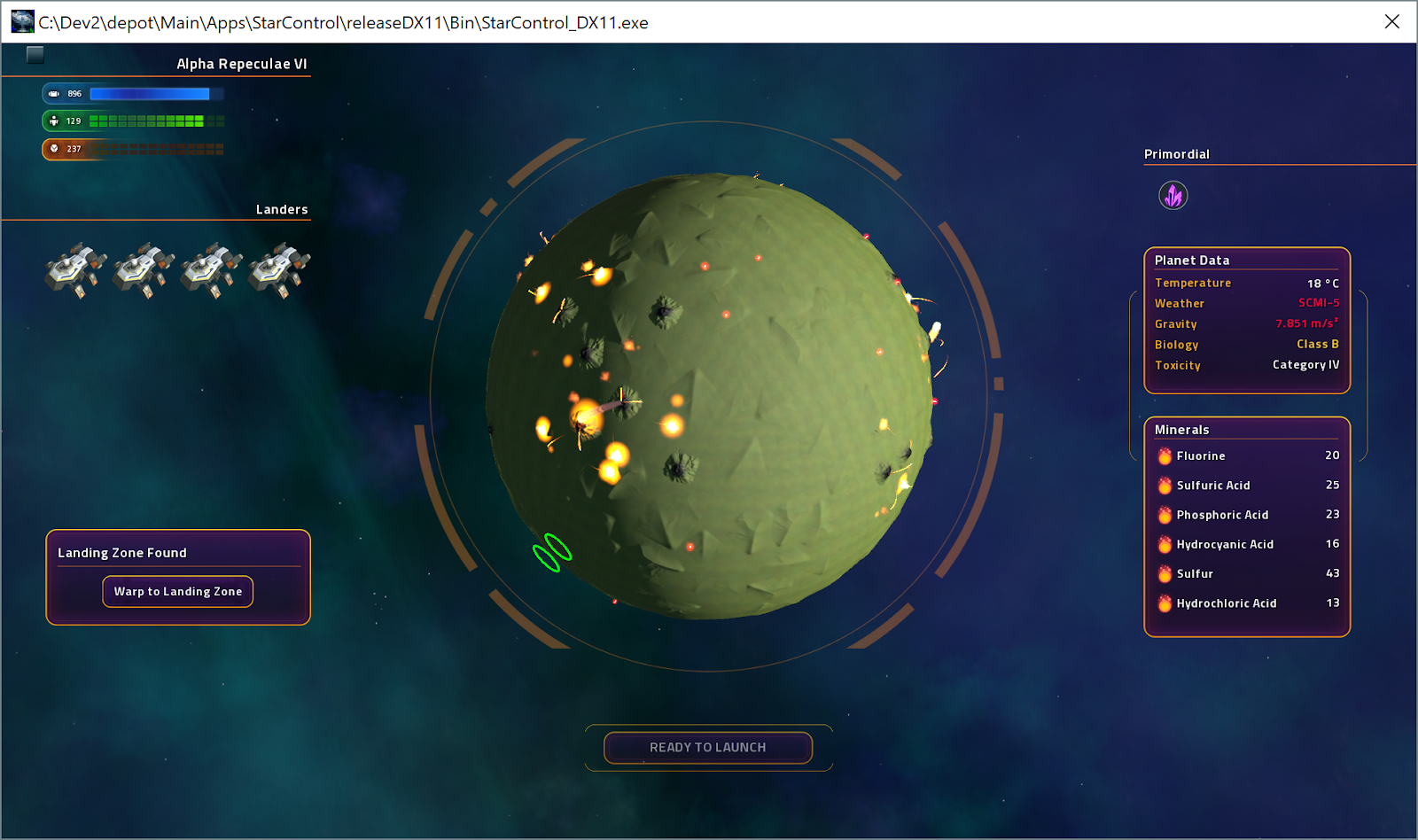
Yea...not so pretty
But that's ok. We can fix all that.

We start with our planet template which is called...wait for it...Primordial. This file refers to materials (what thinks look like) and stamps (what things are shaped like).
In the game, they're located here:
In assets\PlanetTemplate are the types for every planet.
In assets\Terrain is the default.terrainmaterial set.
In assets\Stamplists the stamplists are available.
In assets\Stamps are the stamps the stamplists use.
Setting it up
From my Primoridal planet template, I set up the stats and choose my stamp list. The stamp list is a series of stamps with weighting on them that helps determine the odds of a given stamp being chosen for a particular planet at a particular time. This way, every planet looks different.
Choose our stamps and weights
Now that I've set up my stats (the weather, what minerals are likely to show up, odds of life, temperature, gravity, etc.), I choose what stamps will be on there. Now, the fun starts.
That's just me picking 6 stamps and putting them up. Just curious what that will do. I hit F5 on the planet and...
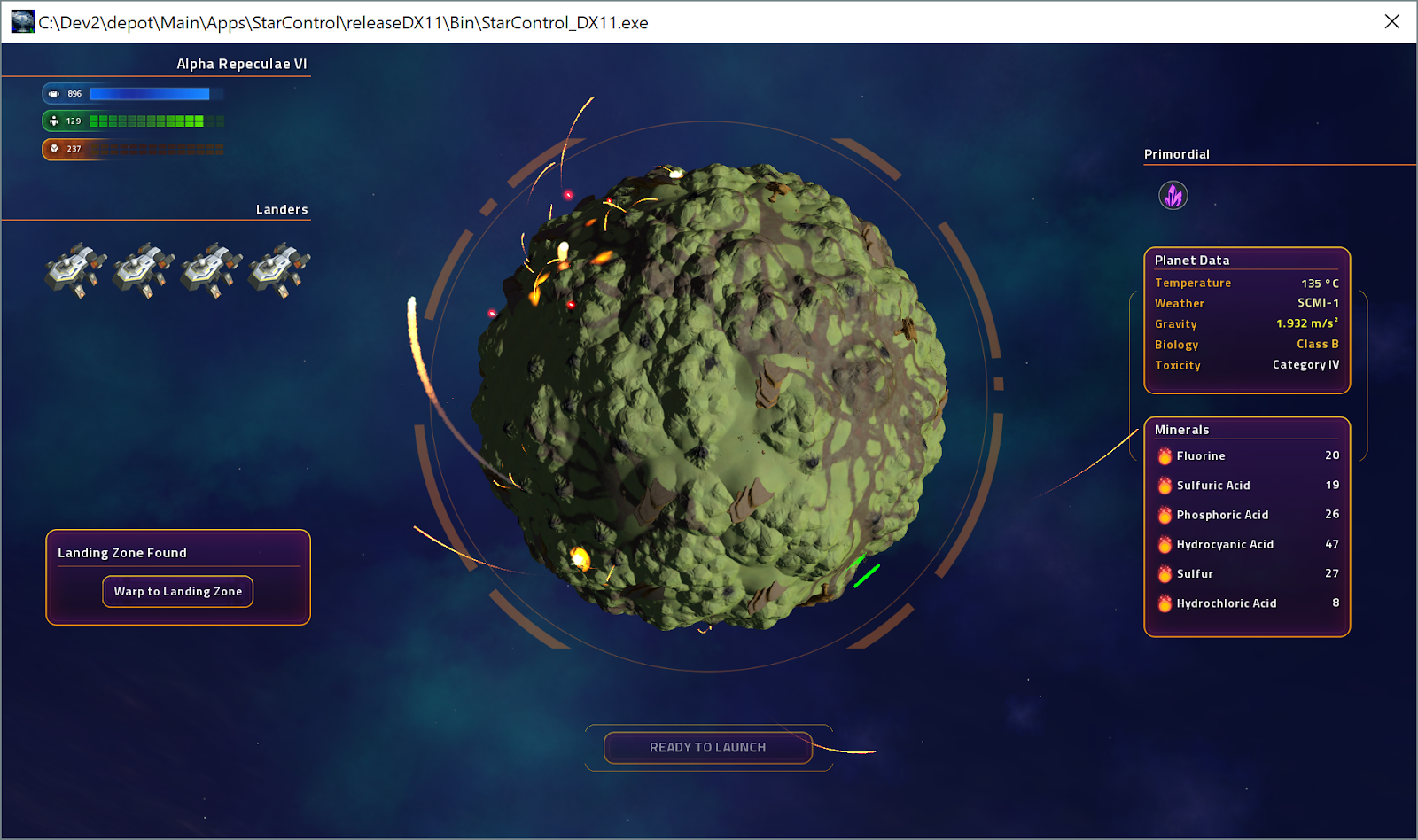
Mmmm. Bumpy.
Trial and Error
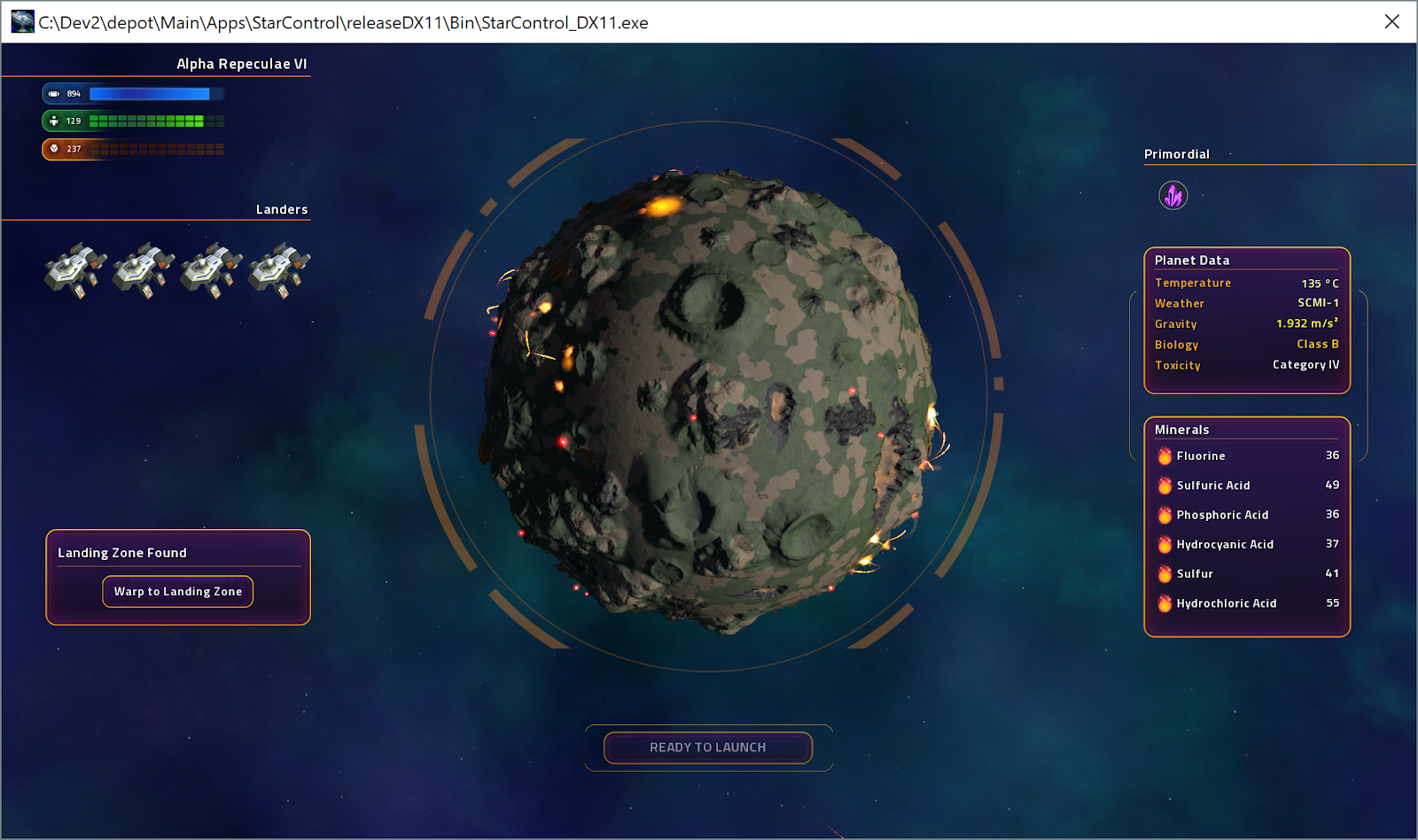
Over the next several minutes I pick various other stamps and end up with this:
Time for some atmosphere
Back in the planet template file, I can set up my atmosphere. Basically, what color is it, how transparent it is, and how thick is it.
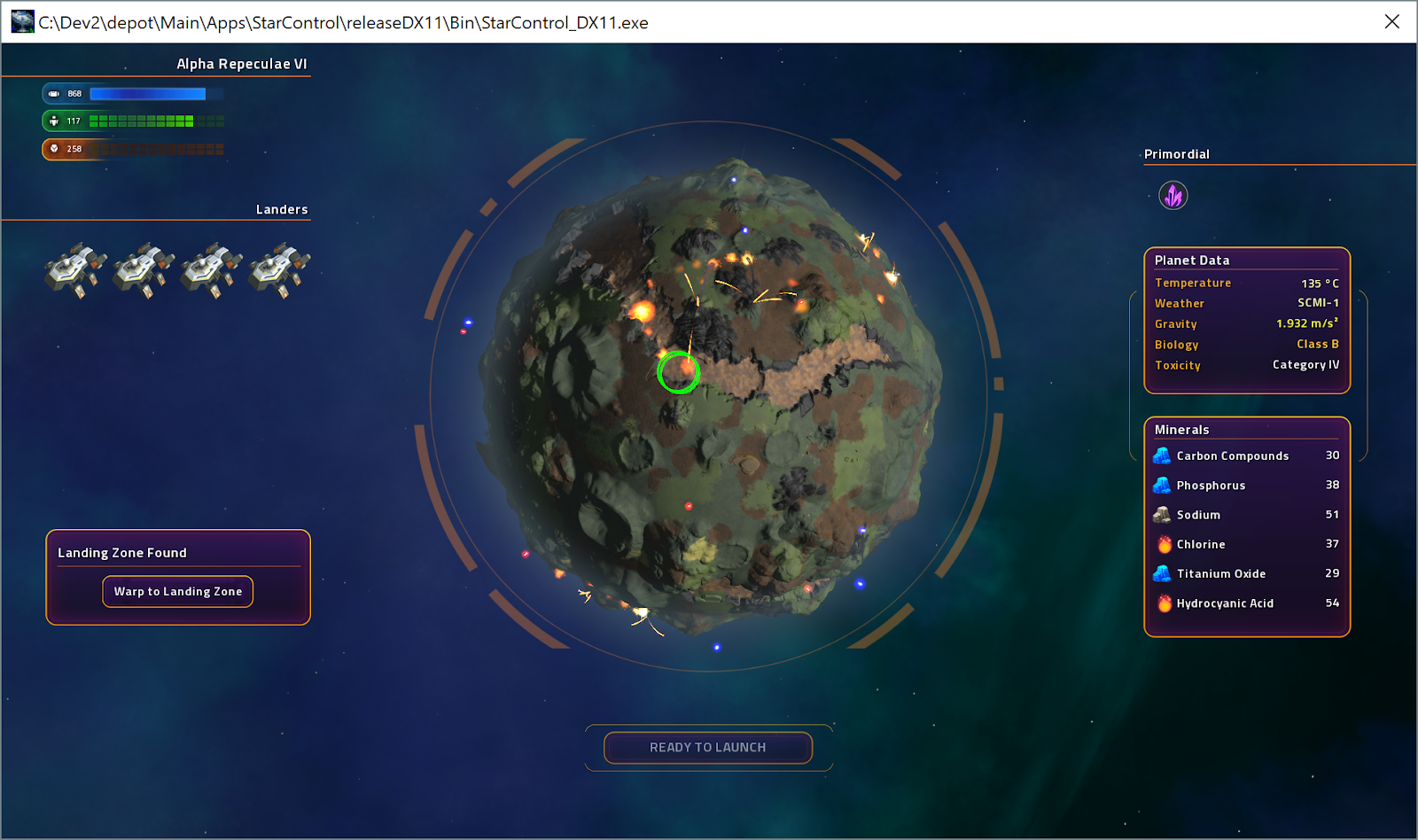
Final Result
My Primordial planet
Now it's ready to leave the designer's "programmer art" state and move to the artists for further polishing and iteration over the months.
This is just one class of planet. Each planet of this class will be different. But you can also create specific, individual planets that can look like anything you want.
I suspect there will be a big library of planet classes made by fans (as well as specific planets) that will easily blow away my quick work here, or even the final effort, based on what I've seen people do in other games.
Feel free to ask any questions.

The premise of Galactic Civilizations is that you have united your homeworld and are now ready to send your first colony ship off into space. What kind of alien worlds do you think we can settle?
The reality is, many worlds are not going to be safe for us. We'll have to live in environmentally sealed enclosures at first. Not because they are too cold or lack the right atmospheric conditions (though that is an issue), but rather because many worlds will have microbes that just aren't compatible with our biology.
In the prime Star Control universe (Origins) the Star Control project was formed to find out what happened to the post-singularity species, the Lexites after they left Earth.
Star Control: Origins represents the third universe that players have been able to adventure in.
Let's recap:
Star Control 1/2:
Year: 2120s and on:
Earth is fighting a losing war with its allies, the Alliance of Free Stars against the Ur-Quan Hierarchy. In Star Control 2, the player is the captain of a Precursor vessel that must find a way to bring the defeated allies together and stop the Kohr-Ah, the Ur-Quan's sibling species, from annihilation all life in this area of space.
Star Control 3:
Year: 2120s and on:
In this alternative universe, the Alliance of Free Stars won the war against the Hierarchy but at the cost of destroying Hyperspace as we know it. Now, a new enemy arises who thrives on a universe without Hyperspace and you must save the day. This is our retcon so that we can make clear that Star Control I/II and III are in different universes. Thus, if the story from Star Control II is continued in the future, it can be done so while easily ignoring the events of III.
Star Control: Origins
Year: 2088:
Earth's radio signals have been detected by the malevolent Scryve Empire who dominate our area of space. They see the potential in humanity and wish to obliterate the humans before they reach their potential. You must find a way to stop the Scryve before they discover the location of Earth. Good luck though as the humans of 2086 are about as ready to handle this as...well, what you'd expect the humans of 2088.
---
Each of the 3 universes have important differences.
Star Control I/II is the beloved classic released by Accolade 25 years ago.
Star Control III is...less beloved (also released by Accolade) around 20 years ago.
Most people (90%) won't be familiar with the classic games which is another reason why Star Control: Origins has a clean start.
Here is one fact we can reveal:
In Star Control: Origins there was no Sentient Milieu like there was in the backstory for Star Control 2. Thus, all the species evolved very differently than they might have done so.
In Origins, a powerful empire known as the Scryve grew to dominate our area of space around 8,000 years ago after overthrowing the "Faction of Eight" who are no longer in this area of space. We don't know who the faction of 8 are or what role the Origins (the multi-dimensional gateways) had in helping the Scryve against the Faction of Eight.
Feel free to comment or ask questions in this thread.
---

People don't like to be taxed. They really don't like to be taxed if they don't have a say in it. The principle cause of the American revolution was not taxation in itself, it was that the colonists didn't have a say in who and what was taxed.

First turn.
Share yours.

Clean up to the ship construction screen.
Also, as a reminder (nag) we would really appreciate it if you would review the game if you haven't already:
http://store.steampowered.com/app/226860/Galactic_Civilizations_III/
The recent reviews are at 41% which makes the game invisible on Steam in searches.