Brad Wardell's Blog


What motivates you to start a business?

Published on Tuesday, October 4, 2005 By Brad Wardell In Business

This December will be the 6th year that Stardock has been a Windows ISV.  In December 1999, Object Desktop for Windows was released. And by this December, WindowBlinds 5 will hopefully be ready for release (though no promises, nothing ships until it's ready). 

Back in 1999, there were only a handful of us in a tiny office in Livonia.  Now, there's over three-dozen of us in multiple locations.  I think the key to having a successful company in the long-term is to develop your skills in spotting talented people.  If there's one thing I can take pride in with regards to the company, it's that we've been able to attract some great talent.

We've got guys who've come to us from Sony, Disney, Maxis, and other very large companies who want a small company environment where their full talents can be unleashed. The stuff they make is simply incredible.  We've also been able to bring on some star-entry-level talent as well. Kids, just out of college who are incredibly self-motivated and highly skilled are working on a variety of future projects. To use a sports analogy, it's like we got several good first round draft-choices.

The biggest challenges we face going forward are those of scale.  We still don't have a director of business development.  Our direct-sales force is still understaffed and under-performing.  Those are areas I'm trying to find top-notch people for but it's difficult to get just the right individual for each of those positions -- especially in the midwest.

People looking from the outside see a company, a corporation.  On the inside, we're just a bunch of guys trying to balance having a successful business with having an enjoyable environment.  Even with our steady growth in revenue, we could be making more -- a lot more if we wanted to be a different kind of company.  But wealth generation is not my primary motivation. It is, really, a side-effect of what we do.  We want to make really cool stuff and have a good time while we make it. And we are fortunate enough that other people want the cool stuff we make.

Running a company is often very rewarding and sometimes very frustrating. But it's always interesting.  I don't necessarily recommend it for most people. I think it all depends on what the goal is.  My goal in having a company was to have some level of control over my life.  I think if making lots of money was the goal, things would not have turned out as well.  I think that it's because we've focused on doing things that are cool to work on that we have been able to attract such wonderful, talented people who in turn are able to create things that do happen to make a lot of money. 

WindowBlinds 5 Preview Guide

Published on Monday, October 3, 2005 By Brad Wardell In WindowBlinds

Version 5

Preview Guide

Our story so far..

WindowBlinds is a program that can completely customize the Windows user interface (title bars, star bar, push buttons, scrollbars, etc.).

Since its initial release in 1999, 4 versions of WindowBlinds have been released.  When Stardock began working on WindowBlinds, no one else had ever attempted to do something like it.  Getting it to work on the various versions of Windows was a real challenge and in early versions, performance was sacrificed to attempt to gain some level of stability on those older operating systems.

In 2001, Microsoft implemented a new look into Windows XP and used a GUI architecture that worked similarly to how WindowBlinds worked.  Stardock was able to make use of that architecture with WindowBlinds 4. At the same time, video card vendors were starting to optimize their drivers for Windows XP.  As a result, by WindowBlinds 4.5, the program not only could make Windows look terrific, it could make Windows run faster.  By caching drawing via the card's video memory, WindowBlinds could substantially increase the rate in which window resizing and repainting occurred. 

Users continued to request new features. Two features were at the top of the list: First, alpha blended title bars and borders.  That is, title bars and borders that could blend in to whatever was behind them to eliminate jaggies and allow skins to be semi-transparent like a piece of glass.  Secondly, user requested the elimination of wbload.exe, the process required to manage the WindowBlinds skins. 

After two-years of effort, Stardock is about ready to deliver WindowBlinds 5 which can produce glass/alpha blended effects on Windows XP with virtually no slow-down (on a modern video card) and now makes use of some built in system APIs to manage WindowBlinds visual styles which allows for the elimination of wbload.exe.  WindowBlinds 5 is effectively a native part of Windows XP.

Glass Effects

 
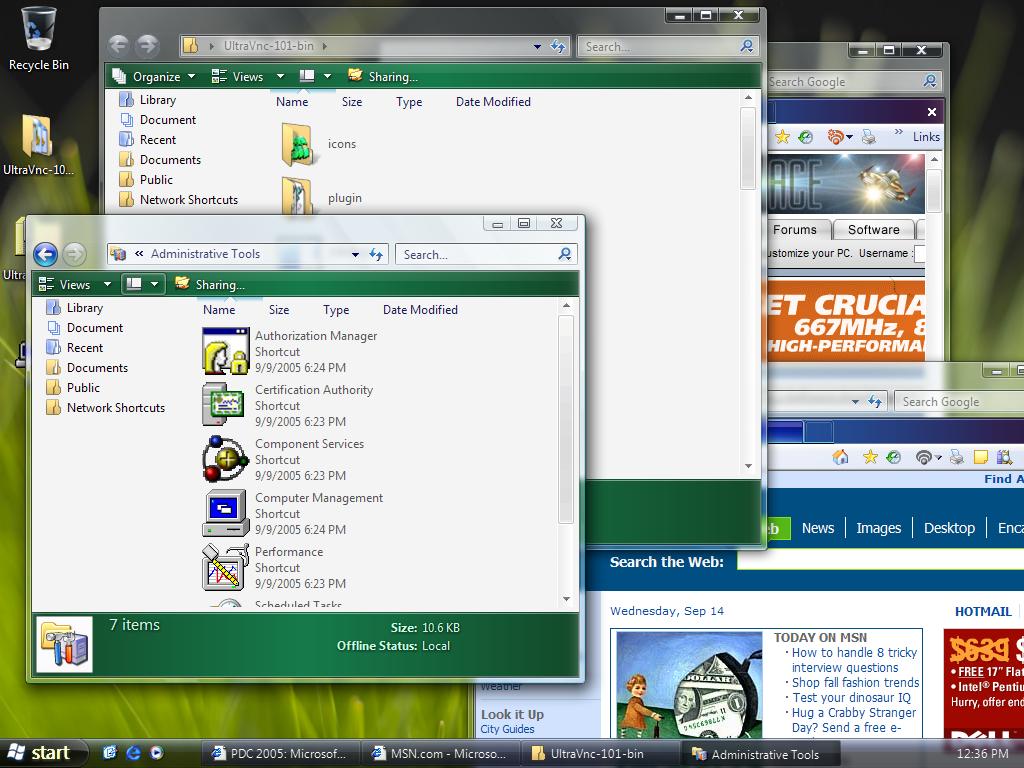
Left: Windows Vista, Right: Windows XP with WindowBlinds 5 Beta.

When user first began seeing screenshots of Microsoft's cool new Windows Vista with its cool glassy effects, many wondered if the same thing could be done on Windows.  Most technical people (including many at Stardock) believed that having glass effects on Windows XP was essentially impossible to do with any kind of decent performance.  On Windows Vista, the entire desktop is composited as a single 3D surface (like you'd see in a modern PC game).  That means on Windows Vista, effects get the full benefit of your modern 3D graphics card.  On Windows XP, that isn't the case.  What makes WindowBlinds 5 so special is that Stardock managed to find a way to bring glass effects to Windows XP yet still have a high level of graphics performance (i.e. moving and resizing windows).  A video card with 64 MB of video memory from ATI or nVidia should be more than enough to get good performance.

More than Glass

While making Windows XP look like Windows Vista is nice, it's not the reason why the alpha blending effects were developed.  Skinning, as an artform, really relies on giving artist as much freedom as possible.  Today, alpha channels (different levels of visibility) are a basic part of virtually any graphical element. So to force tile bars and borders to be either totally visible or totally transparent was very limiting.  For one thing, it means that there's jaggies on the edges of skins.

Consider Windows XP's UI:

See the jaggies?


Look very closely at the edges and you see that they try to blend in.  It's a subtle effect but overall allows the operating system to look more smooth, more polished. Combine glass effects and anti-aliasing and you can get some really neat stuff:

Screenshots

This is Stardock's Aura Skin.  If Stardock were making an operating system, this is the design it would go for.  It comes with WindowBlinds 5.


This is StealthOS.  It too comes with WindowBlinds 5.


This is 5imple - Alpha edition.  As you can see, WindowBlinds 5 can still change colors of your GUI, even on glass.

Getting WindowBlinds 5

WindowBlinds 5 is in beta and will only be available on Object Desktop until it nears release.  User who purchase WindowBlinds 4.x from September 1, 2005 on will receive WindowBlinds 5 for free when it is released.  Other owners of WindowBlinds 4 will be able to upgrade to WindowBlinds 5 at a reduced cost.

To get Object Desktop, which is Stardock's premiere suite of Windows enhancement software, go to www.objectdesktop.com

WinCustomize Subscription Drive: Day 3

Published on Monday, October 3, 2005 By Brad Wardell In WinCustomize News

As we near the end of day 3, WinCustomize.com has 128 new/renewed subscribers.  To get to our 2000 goal we have to average 64 per day.  By subscribing to WinCustomize.com you not help keep WinCustomize.com up and running but you also get unlimited downloads, two premium suites plus a new one that that is being worked on, no advertisements on the site, a personal page, a personal photo album with 20 megabytes of disk space, a personal blog with your own partial domain name and more.  You also get the WinCustomize browser.

The WinCustomize browser is a unique program that taps directly into WinCustomize.com's database.  Not only does it quickly retrieve the most popular skins, the latest downloads, and our full directory of skins, themes, wallpapers, etc.  It is also able to directly apply that content.  Whether it be a wallpaper, a Windows Media Player skin, an icon package, or even a WindowBlinds skin, you can select a given skin, press a button and it'll instantly download and apply it for you (as long as you have the corresponding program installed and if not, it'll prompt you and download the program for you!). The Browser also integrates seamlessly into the WinCustomize forums.  It's the fastest, easiest way to access the forums on WinCustomize. 

And if that wasn't enough, there's also the WinCustomize system tray notifier.  Simply load it up and it sits in your system tray notifying you when new content has come on-line (user settable).  The newest skins, the hottest themes, and latest news are always just a click away.

These are just some of the things user get for $19.95. It's an incredible variety of software, content, and site services.  In a world where many sites and services are charging $15 to $25 per month, WinCustomize provides a great deal of bang for the buck.

Office 12 gets Native PDF support

Published on Monday, October 3, 2005 By Brad Wardell In WinCustomize News

Steven Sinofsky (Senior Vice President, Microsoft Office) has announced that Microsoft is planning to build in native support for the PDF format in Office "12".

The PDF support will be built into Word, Excel, PowerPoint, Access, Publisher, OneNote, Visio, and InfoPath. There is no word on whether customers will be able to use support in Outlook. The new functionality will work in combination with the new Open XML formats in Word, Excel, and PowerPoint. Microsoft wants to ensure that sharing documents across multiple platforms and long term archiving are easily available. Customers now have several options, with the existing support for HTML and RTF, and now the new support for Open XML formats and PDF.

Brian Jones (Program Manager, Microsoft Office) commented on his blog that "this really all comes down to the basic theme of content sharing. We realize that this is a really important scenario, and that's why we're making the move to default XML formats that are fully documented. Now we've moved to the files being in open, redistributable, and archivable formats; and we can focus more of our innovations around ways to act on those formats. This is true on the client and the server."

Office 12 is currently undergoing internal testing and is expected to be released in beta form in November.

PowerUser.TV: Episode 9 - iPod Nano, Wiki Books, and more!

Published on Monday, October 3, 2005 By Brad Wardell In WinCustomize News
The newest edition of WinCustomize.com's official podcast, PowerUser.tv is up and available to listen to. Kristin talks with the gang about problems with the iPod Nano (and a cheap fix for it), VoIP service possibly being disrupted by the FCC due to issues with 911 calls, and Wikipedia crating Wikibooks, a planned library of textbooks that they hope will someday replace paper textbooks. Guests: Derek Batting of www.neowin.net, Tom Chick of www.quartertothree.com and Brad Wardell of www.wincustomize.com.

GalCiv unit technobabble

Published on Sunday, October 2, 2005 By Brad Wardell In GalCiv Journals

The map does not scale planets and stars in a way that is realistic in the absolute sense.  That's because the basis of interstellar travel rests on folding space.  Ships don’t travel that fast in real terms. Instead, propulsion systems such as HyperDrive (the key technology in the background of the GalCiv universe) fold space so that traveling from Point A to Point B is far less in real distance.  However, folding space is dramatically interfered with by mass – planets and stars.  As a result, the folding of space inside a solar system is far less than how much interstellar space is.  Hence, it takes longer to travel from planet to planet than it does to travel in deep space.  The game map is hence visually adjusted (much like a flat map of the world distorts the size of countries – Greenland looks huge on a flat map of the Earth) to support this mode of space travel.


The unit of measurement used to describe space travel is the adjusted parsec or just “parsec”.  The term parsec we know in the 20th century is called a “true parsec”.  But a true parsec has no concept of how folded space operates. 


A true parsec is 3.26 light years. An adjusted parsec varies from 1.9 x 10^6  (million) miles to 1.9 x 10^14 miles depending on how much mass is in the area.


Simply put, a GalCiv ship that moves 1 move per turn is moving 1pc (adjusted parsec) per turn.  Going from Earth to Jupiter might take 2 moves.  Going from Earth to Sirius 8 moves or 8pc. Sirus is 0.8 true parsecs away in the real universe.


Here are the units in the game:

  • Sensor range is in adjusted parsecs: pc. How many tiles out a player can see around a given ship.
  • Ship range is in sectors (sct).  It’s how far away from a friendly planet (or starbase) a ship can travel as measured in sectors.
  • Money is in billions of credits (bc).  It’s billions because credits by the 23rd century have become the standardize form of galactic currency and no one is going to be building an interstellar cruiser for 120 credits. 

Cultural Influence:

Influence is in “ip” (influence points).


The way cultural take overs will work in GalCiv II is that when you click on a planet, there is a floating point number by influence:


23ip (0.45).  The floating point represents alien influence versus native influence.  If the number is >1 then that means alien influence is greater than native influence.  If the number increases beyond 4.0 then that means alien influence is >4 times as much as native influence. That planet may revolt and become part of the civilization they feel more in common with.

Beta 4 schedule

Published on Sunday, October 2, 2005 By Brad Wardell In Galactic Civilizations II

Thursday October 27th is when we plan to release Beta 4.

It will be available to all users who pre-ordered the game.  Beta 4 will be the official start of the main beta stage of the game.  That is, when the game is starting to come together.  Major new features can't be added at that stage but tons of playability features can still be added. And often, what makes a good game great are little touches.

Beta 4 is going to have the diplomacy in it. It will also have the fleets and fleet battles and hopefully the full starbase implementations in them.  There will hopefully be a few custom maps in it as well as a couple of custom scenarios.

There will be regular updates to Beta 4 going into Christmas.  Users who are particularly helpful will be given access to private beta and content that we especially need constructive feedback on.

The campaign, "Dread Lords", won't be in the public beta since the surprise ending is a major issue we don't want to spoil.

Top Advocates: September 2005

Published on Sunday, October 2, 2005 By Brad Wardell In WinCustomize News
Advocates are users whose skins, themes, wallpapers, icons, forum posts, articles attract visitors from other sites. When someone comes to WinCustomize.com from another site through a link, the user who created what is linked to receives an advocacy point. Top advocates are elligible to receive random WC goodies.

This month, well, I kicked butt. That was because of the Microsoft PDC coverage (ex) which got a lot of people to come over (271,405 clicks to WC from other sites).  You can check the "referrrals" button on the bottom of a post to see who is linking to that post, skin, article, etc. A big things especially to JJ Ying and Steve Grenier who had very impressive advocacy ratings this month too.  To everyone who helps promote and advocate Windows customization - thank you!

1  Frogboy 271,405


2  JJ Ying 21,563


3  Steve Grenier 19,651


4  Jairo Boudewyn 10,743


5  mormegil 9,392


6  The Skins Factory 7,427


7  Tandis 6,453


8  wstaylor 6,144


9  Iben 5,420


10  KoL_ 4,413